 ultimate-guide
Commercial Drainage Maintenance Contracts: A UK Buyer's Guide
Last Updated: November 2, 2026
Quick Summary
Commercial drainage maintenance contracts in the UK are written agreements under which a specialist contractor inspects, clears and maintains a building's drainage for an agreed period, usually combining scheduled jetting, interceptor cleaning, CCTV inspection and reactive attendance. Scope varies, so check the schedule of services. Planned maintenance spreads cost and reduces the risk of disruption.
- Scope varies widely, so read the schedule of services rather than the headline.
- Ask for scheduled inspections, preventive jetting and condition reports to be named and priced separately.
- Three main structures exist: fixed-price, schedule-based and call-off arrangements.
- Settle whether emergency out-of-hours attendance is included, charged per visit, or capped.
- Long-term contracts should include a review point, a clear termination clause and shared performance records.
Table of Contents
- What a Commercial Drainage Maintenance Contract Covers
- Planned Drainage Maintenance Versus Reactive Call-Outs
- Comparing Contract Types: Fixed, Schedule-Based and Call-Off Arrangements
- How Often Commercial Drains Should Be Inspected and Cleaned
- The Role of CCTV Drain Surveys for Businesses
- Whether Emergency Call-Outs Are Included
- Key Features to Look for in a Contract
- What a Drainage Maintenance Service-Level Agreement Should Include
- Understanding Pricing, Variations and Hidden Costs
- Risks of Long-Term Contracts and How to Manage Them
- Benefits of a Maintenance Contract for Your Business
- Commercial Drainage Contract Checklist for Choosing a Provider
- Booking a Drainage Maintenance Review with Pro Drain Experts
- Frequently Asked Questions
Commercial drainage maintenance contracts in the UK give property owners and facilities managers a planned way to keep drains working, rather than waiting for a blockage to halt a site. This guide from Pro Drain Experts explains what these contracts cover, how the main contract types differ, and what to check before signing. Public-sector buyers alone generate a large volume of drainage work: Bidstats reports 399 UK government procurement notices containing "drainage" over the past year (Bidstats UK drainage contracts listing), though that figure counts notices, not maintenance agreements awarded. Our team at Pro Drain Experts works across East Sussex, West Sussex and Kent.
What a Commercial Drainage Maintenance Contract Covers
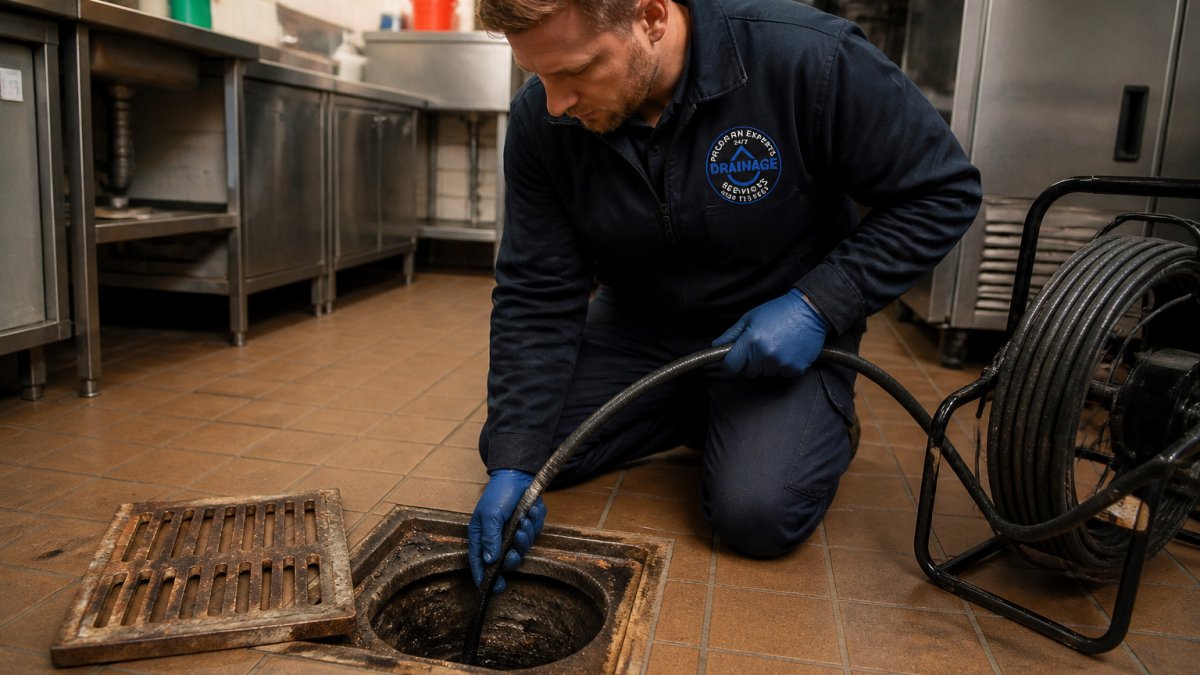
A commercial drainage maintenance contract is a written agreement under which a specialist contractor inspects, clears and maintains a building's drainage system for an agreed period, and commercial drainage maintenance contracts are often reviewed on an agreed schedule. Scope varies widely, so read the schedule of services rather than the headline. Most agreements cover some combination of scheduled jetting, interceptor cleaning, CCTV inspection and reactive attendance when a fault occurs.
Scheduled inspections and preventive work are commonly listed as core components. Aqua Speed drainage contract maintenance services describes scheduled CCTV inspections, preventive high-pressure jetting and detailed condition reports as typical contract elements. Ask for each of these to be named and priced separately, so you know exactly what you are buying.
Planned Drainage Maintenance Versus Reactive Call-Outs
Planned maintenance means work carried out on a timetable before anything fails. Reactive call-outs mean paying for a contractor to attend once a problem has already happened. The two approaches cost different amounts and carry different risks.
Planned work spreads cost across the year and reduces the chance of a blocked kitchen or car park gully stopping trade. Reactive work is quicker to buy but leaves you exposed during the gap between fault and attendance.
Comparing Contract Types: Fixed, Schedule-Based and Call-Off Arrangements
Three broad structures appear in UK commercial drainage work, and each suits a different kind of site.
- Fixed-price contracts set one annual fee for an agreed list of services. They suit sites with predictable needs and a budget that must not vary.
- Schedule-based contracts specify visit frequencies, such as quarterly jetting or six-monthly inspections, with work charged against each visit. They give more control over what happens and when.
- Call-off arrangements provide a framework rate for reactive or ad hoc work, with the client ordering jobs as needed. They suit sites where demand is irregular.
Many contracts combine elements of more than one. What matters is that the structure matches how your site actually behaves, and that variation rules are written down before work starts.
The three main structures each suit a different kind of site:
| Contract type | Best for | Key difference |
|---|---|---|
| Fixed-price | Sites with predictable needs | One annual fee for an agreed list of services |
| Schedule-based | Sites needing control over timing | Set visit frequencies, work charged against each visit |
| Call-off | Sites with irregular demand | Framework rate for reactive or ad hoc work |
How Often Commercial Drains Should Be Inspected and Cleaned
Inspection and cleaning frequency depends on use, not a single national rule. A restaurant grease trap, a warehouse yard gully and an office block soil stack carry very different loads. Use the operator's own history of blockages to set the starting interval, then adjust it after the first year of records.
For food-service premises, shorter cleaning intervals are usually justified. Where the site has a history of recurring faults, increase the frequency until the records show the problem has stopped.
The Role of CCTV Drain Surveys for Businesses
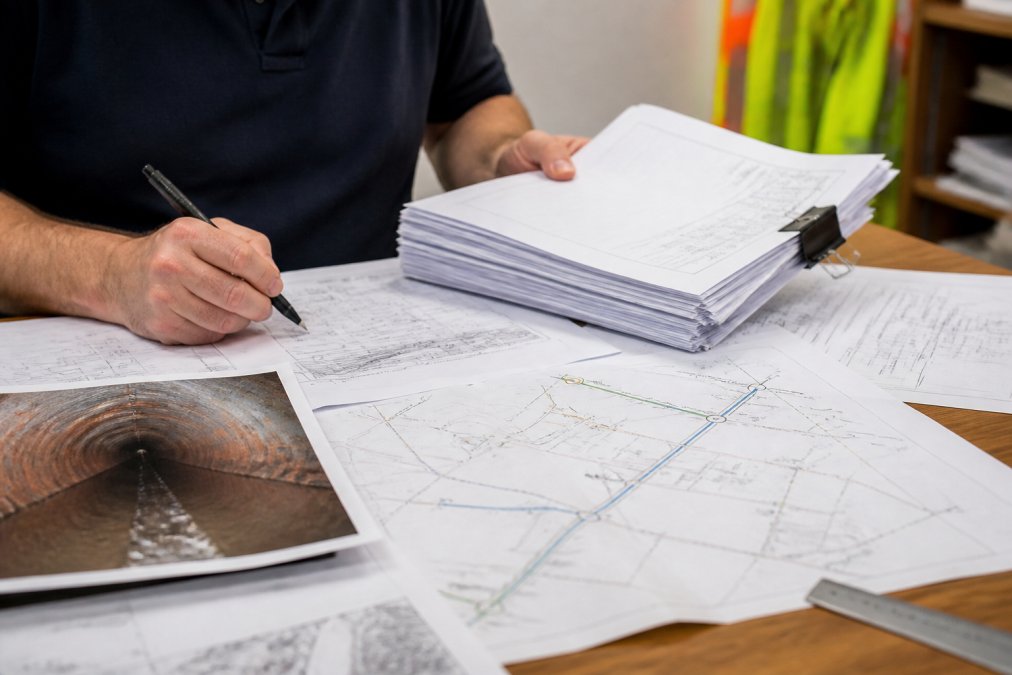
A CCTV drain survey passes a camera through the pipe network to record its condition, locate defects and identify blockages without digging. Learn how a CCTV drainage survey works and what its report contains. The output is usually a recorded video and a written report that maps problems to specific runs of pipe. You can book a CCTV drain survey for your site. For a business, that report is the basis for deciding whether a repair is needed and how urgent it is.
Surveys are most useful when they form part of a planned programme rather than a one-off. Pro Drain Experts provides CCTV surveys with detailed reports and recommendations. A survey done once gives a snapshot; repeated surveys show whether defects are getting worse.
Whether Emergency Call-Outs Are Included
This is one of the most important questions to settle before signing. Some contracts include emergency attendance within the annual fee, others charge it per visit, and some cap the number of call-outs in a year. Check three things: whether out-of-hours attendance is covered, what the response standard is, and what happens if the contractor is already committed elsewhere.
Ask for the emergency terms in writing and compare them with the cost of closure. For a business that cannot afford to shut, the premium for guaranteed attendance is often small by comparison.
Key Features to Look for in a Contract
A commercial drainage contract is only as useful as its terms. When reviewing a proposal, look for the following:
- A clear schedule of services, with each task named and its frequency stated
- Defined response times for emergency and routine attendance
- Written reporting, including condition reports after each visit
- An agreed process for quotes on work outside the schedule
- Insurance and qualification details for the operatives who will attend site
- A stated exit route, including notice periods and what happens to records
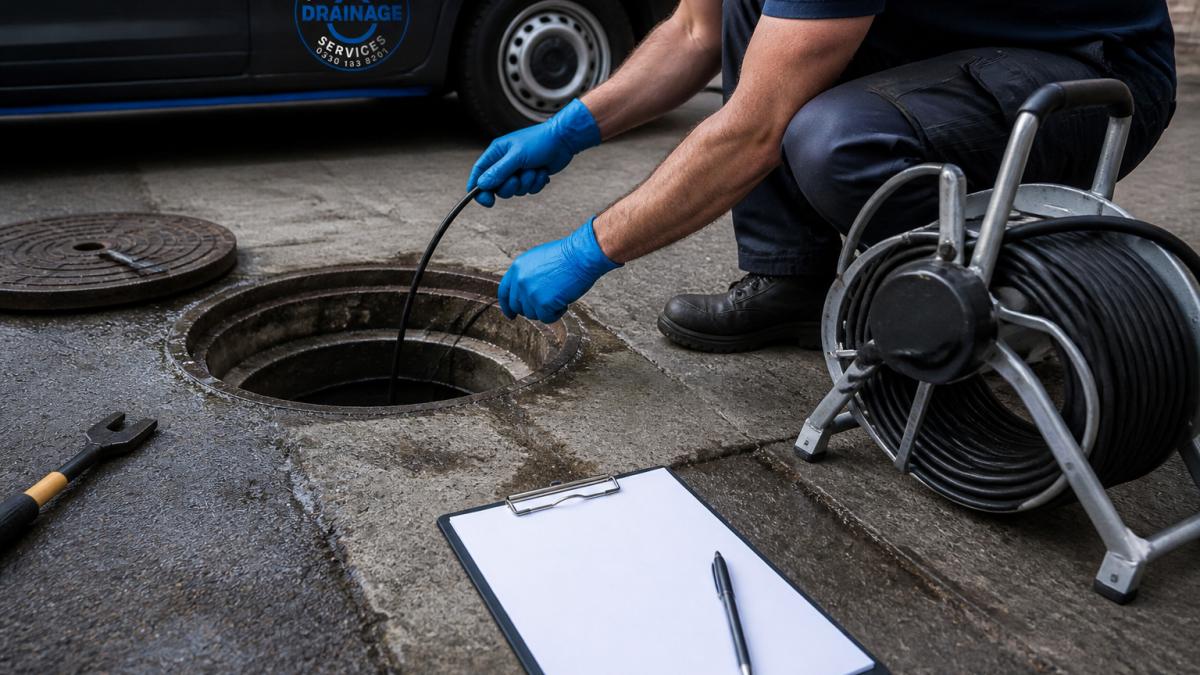
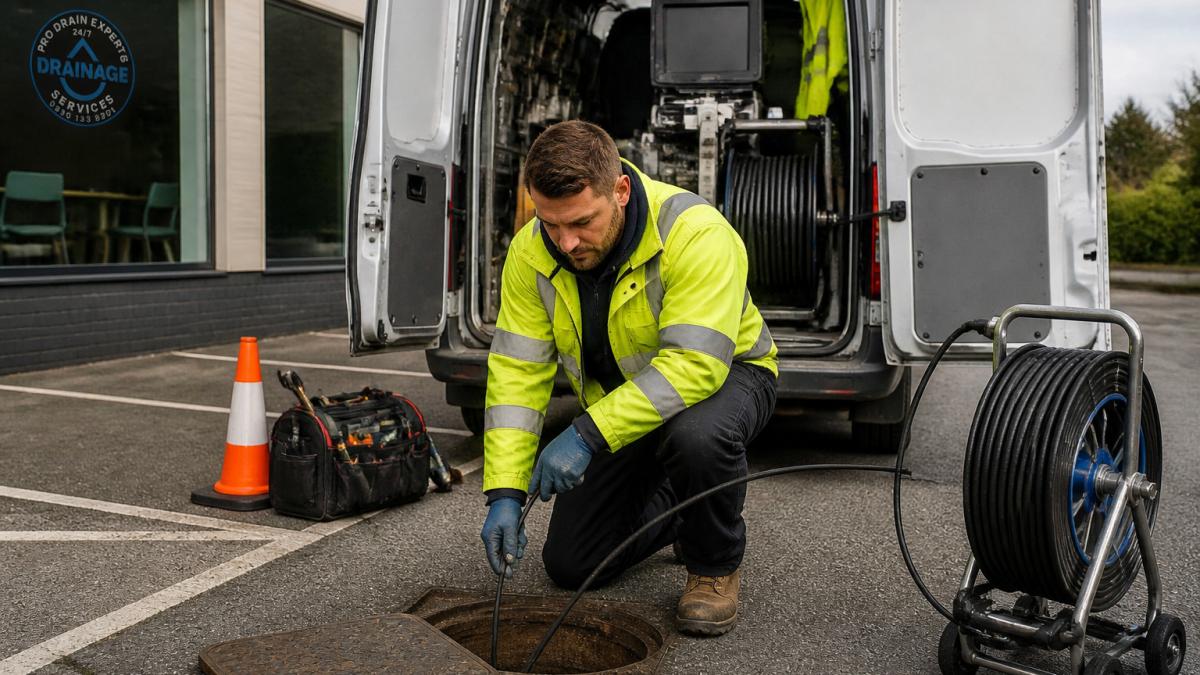
Vehicle and equipment standards also matter. Fully equipped vans mean work can start on the first visit.
What a Drainage Maintenance Service-Level Agreement Should Include
A service-level agreement, or SLA, turns general promises into measurable standards. It is the part of the contract most likely to be argued over later, so it deserves careful drafting. Two areas need particular attention.
Response Times and Attendance Standards
State the maximum time between a reported fault and attendance, and distinguish between emergency and routine categories. Specify whether response times are measured in working hours or around the clock. Tie the standard to a remedy, such as a credit against the next invoice, so the commitment has consequences if it is missed.
Reporting, Records and Recommendations
Every visit should produce a written record: what was done, what was found, and what is recommended next. Request digital copies that you can file for compliance and for future contract reviews. Good records also protect you when a dispute arises about what was agreed.
Understanding Pricing, Variations and Hidden Costs
Pricing should be transparent. Ask every provider for a breakdown showing the annual fee, the rates for chargeable extras and any minimum charges. Be wary of contracts that quote a low headline figure but charge heavily for variations.
Watch for these common costs: call-out fees on top of the annual price, charges for access or waiting time, extra cost for working outside normal hours, and rates for remedial works recommended after a survey. Agree a process for approving any variation before the work begins. Pro Drain Experts offers up-front pricing with no hidden fees. Pricing depends on the size of the system, access and frequency of visits, so request a quote for your site.
Risks of Long-Term Contracts and How to Manage Them
Long contracts bring stability, but they also lock you in. A case study in Frontiers in Built Environment examined contract-management problems and found that a long-term dispute could negatively affect the operation of an owner's business. That study looked at a single case, so it does not show how common such problems are, but it illustrates the risk (Frontiers in Built Environment study on causes and effects of contract management problems).
To manage this risk, keep the initial term sensible, include a review point, set out a clear termination clause, and make sure performance records are shared with you. A provider who is confident in its service should accept these terms without difficulty.
Benefits of a Maintenance Contract for Your Business
The main benefit is predictability. A planned programme replaces unplanned breakdowns with scheduled work you can budget for. Records build up over time, giving you a clear view of the system's condition and helping you plan larger capital works rather than reacting to failures.
Multi-site operators gain consistency. The same standards, reporting format and response expectations apply across every location, which simplifies management and audit.
Commercial Drainage Contract Checklist for Choosing a Provider
Use this checklist when comparing proposals:
- Schedule of services is itemised, with frequencies stated
- Emergency and routine response times are written into the SLA
- Out-of-hours attendance and its cost are clearly stated
- Each visit produces a written report with recommendations
- Variation and quoting process is agreed in writing
- Pricing breakdown is provided with no hidden fees
- Insurance and operative qualifications are confirmed
- Notice periods and exit terms are reasonable
A provider that answers each point plainly is usually easier to work with over the life of the contract.
Booking a Drainage Maintenance Review with Pro Drain Experts
If you manage commercial premises in East Sussex, West Sussex or Kent, the best starting point is a review of your current arrangements and drainage history. Pro Drain Experts can review your current arrangements and provide a quote for planned maintenance. You can also reach our emergency team for urgent faults, and we will explain the options for ongoing cover before any work begins.
Frequently Asked Questions
What does a commercial drainage maintenance contract include?
A commercial drainage maintenance contract typically sets out scheduled inspections, preventive jetting or cleaning, condition reporting and a defined response route for urgent faults. Check whether emergency attendance, CCTV survey frequency and written reports are named explicitly. Pro Drain Experts can set out what a contract covers for your site; for current pricing, contact the team for a quote tailored to your premises.
How often should commercial drains be inspected and cleaned?
The right frequency depends on the type of premises, the volume and nature of what enters the drainage system, and any history of blockages. Restaurants, food premises and multi-unit sites usually need more frequent attention than low-use offices. A provider can recommend an interval after an initial survey.
How much does a commercial drainage maintenance contract cost in the UK?
Pro Drain Experts does not publish standard contract prices, because cost depends on site size, drain layout, inspection frequency and how many call-outs are expected. Ask for a written quotation that separates planned visits from reactive work, and check how variations are priced before you sign. This keeps the figure transparent and avoids surprises during the contract term.
What is the difference between planned and reactive drainage maintenance?
Planned drainage maintenance is scheduled work carried out at set intervals, such as inspections, jetting and cleaning, to prevent faults. Reactive work is attended only when a problem occurs, such as a blockage or flooding. A well-structured contract combines both, so routine work reduces the chance of emergencies and urgent attendance is available when needed.
Do commercial drainage contracts include emergency call-outs?
Some do and some do not, so read the contract carefully. Look for a stated out-of-hours attendance route, response times and whether call-outs are charged separately. Pro Drain Experts offers 24/7 emergency call-out services and a same-day response promise for drainage emergencies across East Sussex, West Sussex and Kent. Confirm exactly how these apply to a maintenance agreement before you commit.
How do I choose a commercial drainage contractor?
Compare providers on qualifications, insurance, response commitments, reporting standards and how clearly they price variations. Ask for references from similar premises and confirm who attends site. A short checklist helps you compare quotes like for like. Pro Drain Experts has over 20 years of experience and a 5-star Google rating.
What should a drainage maintenance service-level agreement include?
A service-level agreement should set out the scope of work, inspection and cleaning intervals, response times for urgent faults, the format and frequency of reports, pricing for planned and reactive work, and the process for agreeing variations. It should also state how performance is reviewed and how either party can end the agreement. Having these terms in writing makes the contract easier to enforce and to review.
Are CCTV drain surveys included in commercial maintenance contracts?
They can be, but inclusion varies between contracts. Some agreements include a periodic CCTV survey as part of planned work, while others charge for it separately. Ask whether the survey is included, how often it is carried out and whether you receive a detailed report with recommendations. Pro Drain Experts provides CCTV surveys with detailed reports and recommendations; contact the team to confirm what your contract would include.