 ultimate-guide
What Is Included in a Professional Drainage Report?
Table of Contents
- What a Professional Drainage Report Actually Contains
- CCTV Footage, Pipe Run Assessment and Defect Coding
- Drainage Survey Grading Codes Explained
- How to Read a Drain Survey Report Without Missing Red Flags
- Drain Mapping, Site Topography and Catchment Area Data
- CCTV Drain Survey Cost and What Drives the Price
- Drainage Strategy Reports for Planning Permission
- Legal, Insurance and Regulatory Implications
- Frequently Asked Questions
Last Updated: September 26, 2026
What a Professional Drainage Report Actually Contains
A professional drainage report is a documented technical assessment of a property's below-ground drainage system, combining CCTV survey footage, pipe run measurements, defect grading and maintenance recommendations. At Pro Drain Experts, we've produced these reports for homeowners, buyers and facilities managers for over two decades, and the difference between a useful report and a useless one comes down to what's inside it.
The Core Sections Every Report Should Have
Every credible drainage report includes six elements:
- Property and survey details - address, date, engineer, weather conditions, equipment used
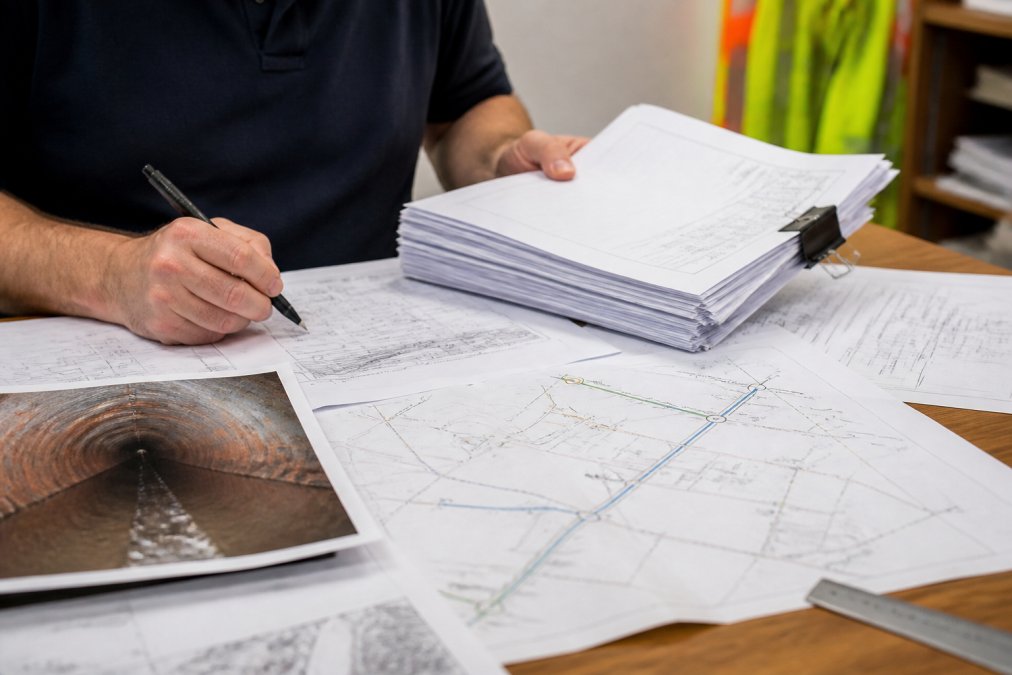
- Drainage layout plan - a drawn map showing pipe runs, chambers, and connections
- CCTV footage and still images - timestamped visual evidence of pipe interiors
- Defect schedule with grading codes - each fault classified by type and severity
- Pipe run assessment - diameter, material, gradient and direction of flow for each section
- Recommendations - prioritised repairs, maintenance intervals, and cost implications
If any are missing, the report won't stand up to scrutiny from a solicitor, insurer or planning officer.
When a Basic Report Is Not Enough
A basic report suits a straightforward blocked drain, not a property purchase, insurance claim or planning application.
CCTV Footage, Pipe Run Assessment and Defect Coding
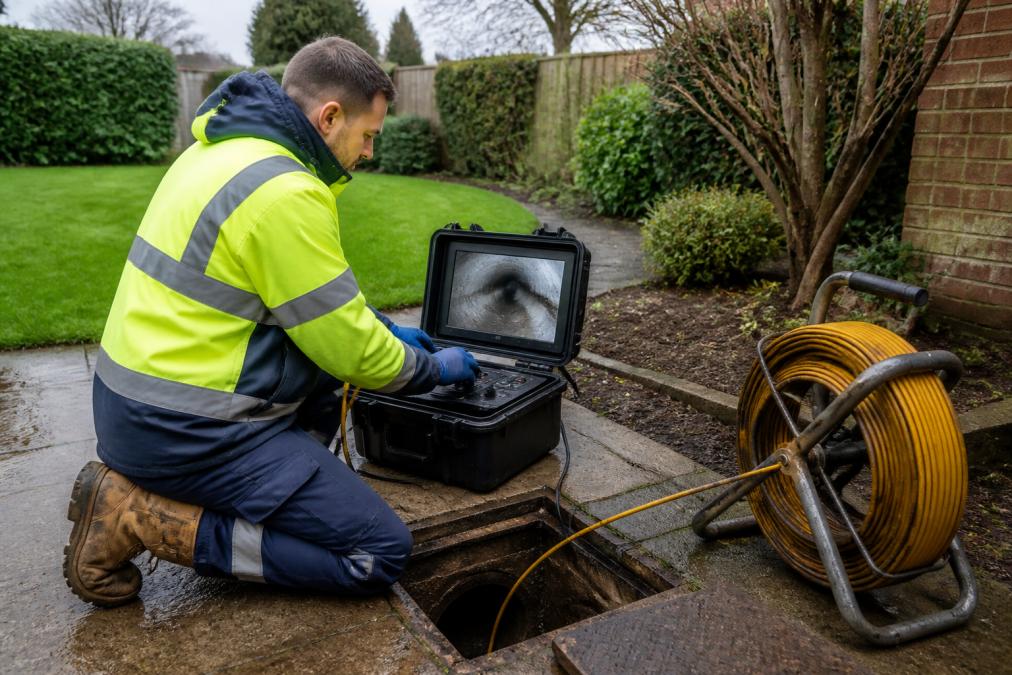
CCTV footage forms the evidential backbone of any drainage report. A remote-controlled crawler camera travels through each pipe run, recording continuous video and still images at every defect, junction and change in pipe material.
What the Camera Records and Why It Matters
The camera captures more than blockages: pipe material (clay, concrete, plastic or pitch fibre), internal diameter, joint condition, root ingress, displaced joints, cracks and signs of ground movement.
Drainage Survey Grading Codes Explained
Drainage survey grading codes classify every defect by severity on a five-point scale from cosmetic to structural failure. The system follows the WRc manual, the Water Research Centre's Manual of Sewer Condition Classification, the recognised industry standard for how to read a drain survey report in the UK. Building control bodies, insurers and solicitors all expect WRc-compliant coding, so a report using its own invented scale is a red flag.
| Grade | Meaning | Typical Action |
|---|---|---|
| 1 | Minor, no action needed | Monitor at next survey |
| 2 | Minor defect, maintain | Clean and re-inspect |
| 3 | Moderate, plan repair | Schedule within 6-12 months |
| 4 | Significant, repair soon | Repair within weeks |
| 5 | Severe, structural failure | Immediate repair or replacement |
Defect Codes vs Grades, They Are Not the Same Thing
WRc uses two parallel systems. The defect code describes what the fault is (a longitudinal crack, a displaced joint, root ingress). The grade describes how bad it is on the 1-5 scale. A report listing codes without grades, or grades without codes, is incomplete, you need both to understand a pipe run.
Why the Same Grade Can Mean Different Things
A grade 3 crack in a clay pipe under a driveway differs from a grade 3 root intrusion in a garden run. Context changes the reading:
- Pipe material, pitch fibre deforms and delaminates in ways clay does not, so a grade 3 in pitch fibre often progresses faster.
- Location, a defect under a building, driveway or highway is far more expensive to access than one under a lawn.
- Depth, a defect in a shallow run is cheaper to excavate than one three metres down.
- Proximity to other defects, clusters suggest ground movement rather than isolated wear.
What a Professional Report Adds Beyond the Codes
A WRc-compliant report should also record, per pipe run: upstream and downstream manhole references, pipe diameter and material, direction of flow, length surveyed, and method used (CCTV, sonar or a combination). Without these, the grades float free of the pipe they describe and the report cannot support a repair specification, insurance claim or planning submission.
How to Read a Drain Survey Report Without Missing Red Flags
Reading a drain survey report means checking four things: the defect schedule, the pipe run assessment, the photographic evidence and the recommendations. If any is vague, ask for clarification before accepting the report.
Red flags to watch for:
- No pipe run lengths or depths recorded - the engineer didn't measure properly
- Photos without timestamps or location tags - impossible to verify which pipe they show
- "Further investigation recommended" without specifics - a way of avoiding a firm conclusion
- No mention of pipe material - material drives repair method and cost
- Recommendations that don't match the grades - a grade 4 defect marked "monitor" is a contradiction
Drain Mapping, Site Topography and Catchment Area Data
Drain mapping converts the survey into a scaled plan, usually a PDF with CAD files or GIS data in DWG or DXF format. This matters for anyone planning works, because it shows exactly where pipes run relative to boundaries, trees and structures.
CCTV Drain Survey Cost and What Drives the Price
CCTV drain survey cost varies with the number of pipe runs, access difficulty, property size, and whether you need CAD drawings or just a written report. Providers quote per run or per property.
What pushes the price up:
- Multiple access points required - more chambers to open and survey
- Deep or obstructed runs - specialist equipment and longer site time
- CAD or GIS deliverables - drafting adds cost
- Out-of-hours or emergency scheduling - premium rates apply
- Combined survey and clearance - jetting before filming
Drainage Strategy Reports for Planning Permission
A drainage strategy report supports a planning application by demonstrating how a development will manage surface water and foul drainage. It differs from a condition survey, though the two often sit together.
Planning authorities expect the strategy to cover:
- Existing drainage network and its capacity
- Proposed connections and any new pipe runs
- Surface water management, including SuDS where feasible
- Hydraulic calculations for peak flows
- Maintenance schedule for the life of the development
Legal, Insurance and Regulatory Implications
A drainage report is a legal document as much as a technical one. It can support a property transaction, back an insurance claim for subsidence or flooding, or evidence compliance with building regulations. The useful part is how it does each of those things, because the mechanism determines whether your report is fit for purpose.
Property Transactions and the Duty to Disclose
In a residential sale, the seller completes a TA6 Property Information Form, which asks directly about drainage and mains connection. If the seller knows of a defect and does not disclose it, they can face a misrepresentation claim after completion. A buyer's pre-purchase CCTV survey is the counterweight: a dated, independent record of pipe condition before exchange, so a later dispute turns on evidence rather than recollection.
Insurance Claims and the Pre-Existing Damage Test
Insurers assess drainage claims on two questions: was the damage sudden and accidental, and was it pre-existing? A CCTV report with timestamps, pipe run references and WRc grades answers both, showing pipe condition at a known date, exactly what's needed to distinguish a sudden collapse from gradual deterioration.
Two practical points most homeowners miss:
- Accidental damage cover typically responds to a single event (a tree root cracking a pipe, a vehicle loading a driveway). Wear and tear is usually excluded, and a report that shows long-standing root ingress or scale will be read as wear and tear.
- Subsidence claims involving drainage often hinge on whether leaking pipes caused soil movement. A report that records the leak location, the pipe condition and the surrounding ground gives the loss adjuster something to work with. A report that says only "drain defective" does not.
Building Regulations and Planning Compliance
For developers and anyone extending a property, a drainage report can evidence compliance with several strands:
- Building Regulations 2010, Part H, covers foul and surface water drainage, including the requirement that drainage work is carried out to a standard that protects health and the environment. A condition survey supports the design and the completion certificate.
- Building Regulations 2010, Part M, relevant where drainage access points affect accessibility.
- The Building Safety Act 2022, for higher-risk buildings, the golden thread of information includes drainage and below-ground services, and a properly coded survey is part of that record.
- Local authority planning conditions, many permissions require a drainage strategy and, in some cases, a condition survey of existing infrastructure before works begin.
- Sewer adoption and the Water Industry Act 1991, where a developer seeks to have new sewers adopted, the report demonstrates the network meets the adopting undertaker's specification.
What This Means in Practice
The same survey can serve several of these purposes, but only if written to the right standard. A report for a homebuyer's peace of mind is not the same as one for a planning submission or insurance claim. Before commissioning, tell the surveyor what the report is for, transaction, claim or compliance, and confirm it will be WRc-coded and reference the relevant regulations.
Frequently Asked Questions
How much does a drainage report cost?
A CCTV drain survey cost depends on the number of pipe runs, access points, and whether you need a full drainage strategy report. A single-run domestic survey costs less than a multi-property commercial assessment. Reports that include CAD drawings, hydraulic calculations, and flood risk evaluation sit at the higher end. For a quote tailored to your property, contact Pro Drain Experts directly.
What do the grading codes in a drainage report mean?
Grading codes follow the WRc coding system, which rates each defect from 1 to 5. A grade 1 is a minor observation with no structural impact. Grade 3 means a defect that will worsen and needs attention. Grades 4 and 5 indicate structural defects or serviceability failures requiring immediate repair. The report should list every defect with its code, location, and recommended action.
How long does it take to receive a professional drainage report?
Most CCTV surveys are completed on site within one to three hours, depending on the size of the property and the number of pipe runs. A written drainage report is typically delivered within 24 to 48 hours. Reports requiring CAD files, GIS data, or drainage strategy documentation for planning permission can take longer. Pro Drain Experts provides same-day response for surveys and clear timelines for report delivery.
Why do I need a drainage report when buying a property?
A standard homebuyer survey does not inspect underground drains. A pre-purchase drainage report uses CCTV to check pipe condition, identify blockages, and flag structural defects before you exchange contracts. It also confirms whether the property drainage network connects correctly to the public sewer. Without one, you risk inheriting repair bills that run into thousands of pounds.
Are drainage reports required for planning permission?
Yes, in most cases. Local planning authorities require a drainage strategy report as part of a planning application. This report must show how surface water and foul water will be managed, including sustainable drainage systems (SuDS) where feasible. It should include site topography, catchment area assessment, flow control calculations, and connection points to existing watercourses or sewers.
What is the difference between a CCTV survey and a drainage strategy report?
A CCTV survey records the physical condition of your pipes using a camera crawler. It produces footage, defect grading codes, and maintenance recommendations. A drainage strategy report is a planning document that describes how a site will manage surface water and foul drainage. It includes hydraulic calculations, SuDS design, and catchment area data. Some projects need both.