 Ultimate guide
Signs of a Leaking Pipe Behind a Wall to Look For
Last Updated: November 10, 2026
Quick Summary
A leaking pipe behind a wall often shows up as a damp patch that persists in dry weather, a brown stain, bubbling paint, or a musty smell. You can confirm it by reading the water meter with all taps off and checking again after an hour, since a moving reading means water is escaping.
- Check for damp that persists after rain has passed, as this points to an internal source.
- Read the water meter with all water use off, then check again after an hour.
- Painting over a stain hides the symptom while the leak continues.
- Do not cut into walls or lift floors yourself to search for the pipe.
- Photograph marks and note dates to help a plumber and any insurer.
Table of Contents
- Why a Hidden Pipe Leak Is Hard to Spot
- Visible Warning Signs: Damp Patches, Stains and Discolouration
- Paint, Wallpaper and Surface Damage to Look For
- Musty Odours, Mould and Mildew
- Sounds and Changes in Water Use: Meter and Bill Clues
- A Safe Step-by-Step Diagnostic Sequence
- Water Supply Pipe or Heating and Waste Pipe: Telling Them Apart
- Limiting Damage Now and When to Call an Emergency Plumber Ringmer
- How Professionals Confirm a Leak and What the Cost of Leak Detection UK Covers
- Booking Your Leak Inspection With Pro Drain Experts
- Frequently Asked Questions
Why a Hidden Pipe Leak Is Hard to Spot
A leaking pipe behind a wall is one of the most common causes of unexplained damage in UK homes, and one of the hardest to find. The pattern is usually the same: the problem only becomes obvious once the damage is already well advanced. Pipe leaks behind plasterboard, in wall cavities or under floors do not announce themselves. The water runs down inside the structure, where nobody can see it.
That concealment is the core difficulty. A dripping tap is easy to diagnose because the water is visible. A pipe concealed in a stud wall may leak for weeks before any sign reaches the surface, and by then the moisture may have spread across timber, insulation and plaster. Knowing what to look for early gives you a much better chance of limiting the damage.
Building Research Establishment guidance on damp and moisture in buildings
Visible Warning Signs: Damp Patches, Stains and Discolouration
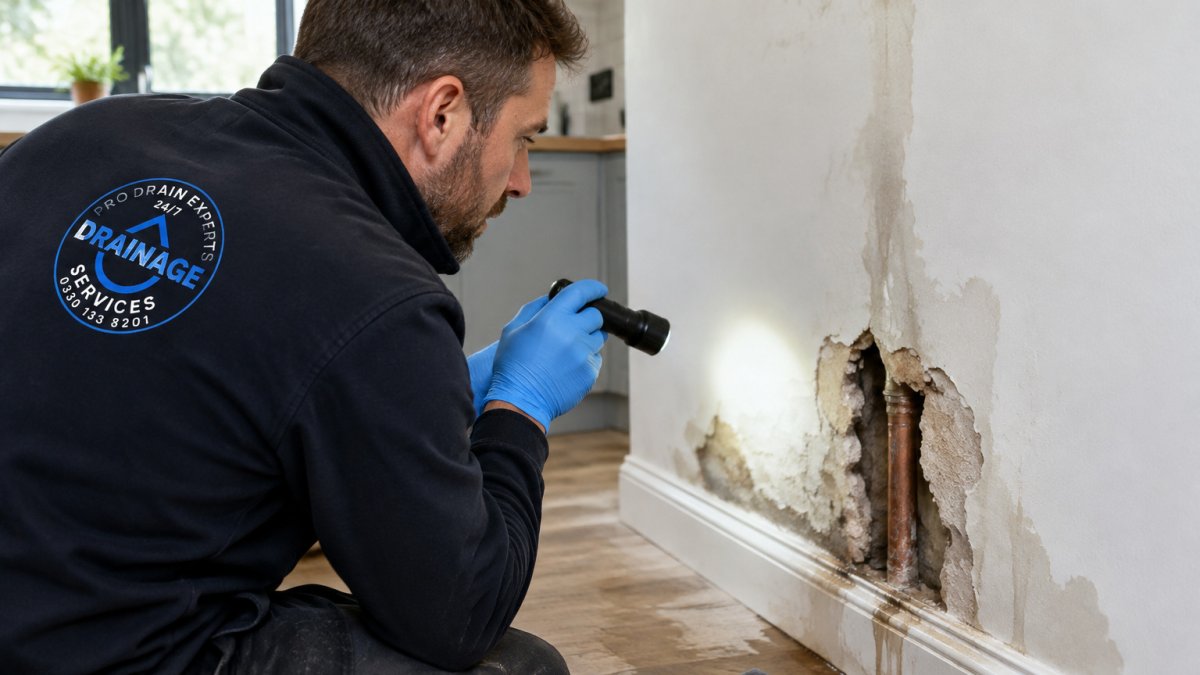
The most common visible sign is a damp patch on a wall or ceiling that appears without an obvious external cause. Check after heavy rain has passed, because a patch that persists when the weather is dry points towards an internal source such as a pipe. Water tracking down through plaster often leaves a brown or yellowish stain, sometimes with a tide-mark ring at its edge where water has dried and deposited minerals.
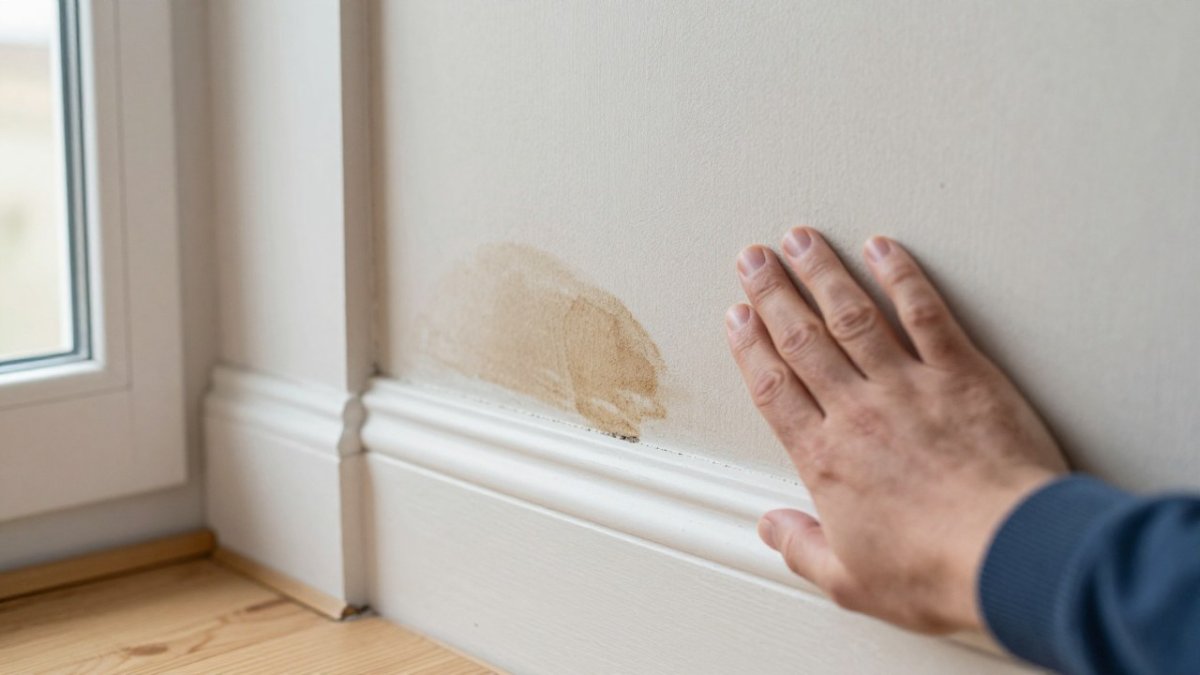
Look at the skirting boards, the bottom of walls near sinks and bathrooms, and any ceiling directly beneath a bathroom or kitchen. A stain that grows slowly or reappears after it has been painted over is a strong indicator. Do not assume a stain is old simply because it looks dry; press gently with a finger, and if the plaster feels soft or crumbles, moisture is still present.
Watch out: painting over a stain without tracing its source is the most common way homeowners lose time. The paint hides the symptom while the leak continues.
Paint, Wallpaper and Surface Damage to Look For
Surface finishes often show damage before anything else does. Paint that bubbles, blisters or peels away from the wall is frequently caused by moisture pushing up from behind. Wallpaper that lifts at the seams, darkens in patches or feels cold and damp to the touch can also point to water trapped beneath the paper.
Pay attention to changes that appear gradually. Mould growth along a skirting board, a line of discolouration that follows the route of a pipe, or grout that turns dark around a wall fitting can all signal a concealed leak nearby. Each sign on its own may have another explanation, which is why it helps to note several together before concluding anything.
Musty Odours, Mould and Mildew
A persistent musty or damp smell in one room, especially one that does not improve with ventilation, is worth investigating. Smells that seem to come from the wall itself, rather than from the room, often indicate moisture inside the structure. Mould and mildew typically follow, appearing as dark spots or fuzzy growth on painted surfaces, around window frames or behind furniture placed against an exterior or plumbed wall.
Mould is more than a cosmetic issue. It can affect indoor air quality, and people with asthma or respiratory sensitivities may find symptoms worsen in affected rooms. Treat any growth as a sign that moisture has been present for some time.
NHS guidance on damp, mould and health
Sounds and Changes in Water Use: Meter and Bill Clues
Listen when the house is quiet and no taps or appliances are running. A continuous drip, hiss or the sound of running water inside a wall can indicate water escaping from a pipe. This is easiest to notice at night, when background noise is low.
Your water bill and meter are equally useful. Read the meter, make sure no water is being used, and check again after an hour or two. If the reading has moved, water is flowing somewhere in the system. An unexplained rise in your water bill without a change in household use is another reason to suspect a hidden leak. Compare the bill with your previous period before blaming usage.
The article points to a few checks that help reveal a hidden leak. The table below summarises them.
| Clue | What it suggests | Action |
|---|---|---|
| Meter moves with no water in use | Water escaping in the system | Read again after an hour |
| Continuous drip or hiss in a wall | Pipe leaking inside the structure | Listen in a quiet room |
| Bill rises without a change in use | Possible hidden leak | Compare with previous bill |
| Damp that persists in dry weather | Internal water source such as a pipe | Trace the source before painting |
A Safe Step-by-Step Diagnostic Sequence
Work through these checks in order, and stop as soon as you have strong evidence of a leak.
- Switch off all water use. Turn off taps, appliances and showers for at least an hour.
- Read the water meter. Note the reading, then check it again after an hour. A change confirms water is escaping.
- Check the visible areas. Look at walls, ceilings and skirting boards near likely pipe routes for stains, damp or bubbling paint.
- Use your sense of touch and smell. Feel the plaster for softness and note any musty odour.
- Listen carefully. Stand still in the affected room during a quiet period and listen for dripping or running water.
- Record what you find. Photograph marks and note the dates. This helps a plumber and any insurer later.
Do not cut into walls or lift floors yourself to search for the pipe. Damaging a concealed pipe can turn a small leak into a major repair.
Water Supply Pipe or Heating and Waste Pipe: Telling Them Apart
Not all hidden leaks behave the same way, and the type of pipe involved changes both the urgency and the repair. Signs alone cannot confirm the source, but the pattern of symptoms can point you towards the right system and help you describe the problem accurately when you call for help.
Water supply pipes carry mains-pressure water to taps, appliances and outside taps. A leak here is usually the most urgent because water is escaping under pressure. You may see a steady damp patch that grows, a drop in water pressure at nearby taps, or a water meter that keeps moving when every outlet is closed. If the leak is on the supply pipe between the boundary stop valve and your property, it may be your responsibility rather than the water company's, so check with your supplier before arranging work.
Heating pipes carry hot water in a sealed circuit connected to the boiler. A leak often shows up as falling pressure on the boiler gauge, radiators that need bleeding repeatedly, or uneven heating. Because the system is sealed, you may not see a meter movement. A heating leak can also cause damp patches that feel warm to the touch, and the water may carry a slight rusty or chemical smell from corrosion inhibitor.
Waste pipes carry used water away from sinks, baths, showers and toilets. Leaks here often produce a musty or foul smell, damp low on walls or under bathroom floors, and staining around the base of a toilet or basin. Waste leaks can be intermittent because they only appear when the fixture is used, so a patch that dries between uses is a clue.
A common pattern is for homeowners to assume every damp patch is a supply leak. In practice, a heating leak can be identified by watching the boiler pressure over 24 hours with the heating off, while a waste leak is more likely if the damp appears only after baths or showers. If you have a water meter, take a reading with all outlets closed and the heating off; if the dial moves, the leak is more likely on the supply side. If it does not move but the boiler pressure falls, suspect the heating circuit.
Watch out: do not assume a leak is on your side of the boundary. Supply pipe responsibility can sit with the water company in some cases, and cutting into the wrong pipe can create a larger problem and complicate any insurance claim.
Limiting Damage Now and When to Call an Emergency Plumber Ringmer
If you find a suspected leak, act quickly. Turn off the water at the stopcock if you can locate it, and shut off the electricity to the affected area if water is near sockets or wiring. Move furniture away from damp walls and place towels or containers to catch drips. Good ventilation helps moisture evaporate, though it will not stop a leak.
Call an emergency drainage specialist if you have water running through ceilings or walls, a rapidly spreading stain, a sudden loss of water pressure, or any sign of water near electrics. Pro Drain Experts offers 24/7 emergency call-out services and a same-day response, so you do not need to wait for an appointment window.
How Professionals Confirm a Leak and What the Cost of Leak Detection UK Covers
A professional confirms a hidden leak using a sequence of non-invasive checks before any wall is opened. Leak detection can involve several non-invasive checks, such as moisture meters, acoustic listening, CCTV drain surveys and thermal imaging, depending on the situation.
The aim is to locate the leak precisely enough to open the smallest possible area. A good leak detection visit should end with a clear explanation of where the leak is, what type of pipe is involved, and what repair is needed. Ask for this in writing.
The cost of leak detection depends on the method used, how much access is needed and how urgent the call is. For a quote for your property, contact Pro Drain Experts directly and ask for a written breakdown covering detection, any access work and the repair itself.
What happens after detection is where many homeowners are left in the dark. A typical repair involves isolating the affected section, cutting a small access hole in plasterboard or lifting a floor covering, replacing the failed section of pipe, and pressure-testing the repair. Drying is then needed before reinstatement; depending on the extent of moisture, this can take days or weeks with air movers and dehumidifiers. Reinstatement covers filling and skimming plaster, refitting skirting, and repainting. If the leak has affected timber or insulation, those materials may need to be replaced rather than dried.
Insurance and evidence matter as much as the repair. Before work begins, photograph the damp, any staining and the meter reading, and keep a dated log of when you first noticed each sign. Keep the leak detection report, the repair invoice and any drying records. Check your home insurance policy for trace-and-access cover, which pays for finding and accessing a hidden leak, and clarify with your insurer whether the repair itself is covered before authorising work. If you rent, tell your landlord in writing and keep a copy.
Water UK guidance on customer supply pipes and leakage
Booking Your Leak Inspection With Pro Drain Experts
If the signs above match what you are seeing, a professional inspection is the fastest route to an answer. Pro Drain Experts has over 20 years of experience with drainage problems, and our vans are fully equipped for the work. We aim to respond the same day.
Before you call, note where you have seen damp, the dates you noticed changes, and any meter readings you have taken. This information lets us prepare for your visit and gives you a clearer diagnosis. Reach out today to book your inspection and get clear, up-front pricing before any work begins.
Frequently Asked Questions
What are the early warning signs of a leaking pipe behind a wall?
The earliest signs are usually a damp or cold patch on the wall, a faint brown water stain, paint that bubbles or peels in one spot, and a musty smell that does not go away. You may also hear dripping or running water inside the wall when no taps are on. Any of these, especially in combination, justifies a check. Note the location and take photographs, then arrange a visual or CCTV inspection so the source can be confirmed before any wall is opened.
Can a hidden water leak cause structural damage to my home?
Yes. Water that soaks into timber, plasterboard or masonry over months can rot joists, weaken plaster and encourage mould, which affects indoor air quality. Damage often develops out of sight, so the first visible sign may appear late. Limiting water exposure early, drying the area and having the leak repaired reduces the scale of building work needed. A professional inspection can show how far the moisture has spread.
Does home insurance in the UK cover water damage from hidden pipe leaks?
Many UK home insurance policies cover sudden water damage and the cost of locating the leak, but cover varies between policies, and gradual leaks or damage from poor maintenance are often excluded. Check your policy wording and ask your insurer what evidence they need. Keep dated photographs, plumber's reports and receipts, as these help support any claim. Speaking to your insurer before arranging major work is sensible.
Should I call an emergency plumber in Ringmer for a suspected wall leak?
If you can hear running water in a wall, see water pooling, or the leak is causing active dripping or ceiling damage, call an emergency drainage specialist straight away. Shut off the water at the stopcock if you know where it is. For a suspected but slow leak, a same-day or next-day inspection is usually enough. Pro Drain Experts offers 24/7 emergency call-out and same-day response, and you can call to arrange a visit.