 How-to
How Drainage Problems Affect Property Value in the UK
Quick Summary
Drainage issues reduce property value because buyers and surveyors treat hidden drain faults as costly risks. They often ask for a lower price, a retention, or repairs before exchange. Commissioning a CCTV drain survey before listing lets sellers choose the repair route and show buyers a clear report.
- Buyers cannot see drains, so they often assume the worst and push for a lower offer.
- Surveyors often recommend a specialist CCTV inspection when a possible defect is flagged.
- Early warning signs include slow drains, gurgling noises, bad smells, and damp walls.
- A CCTV survey records cracks, root ingress, collapsed sections, and misaligned joints without excavation.
- Sellers can repair before listing, disclose and reduce the price, or sell as seen with a known defect.
Table of Contents
- How Drainage Issues Reduce Property Value
- Common Signs of Drainage Problems in a Property
- Why a CCTV Drain Survey Before Selling a House Protects Your Price
- Reading a Professional Drainage Report Step by Step
- Selling a House with Drainage Problems: Your Options
- Drain Repairs Before Selling a Property: Cost Versus Price Reduction
- Insurance, Disclosure and Your Legal Obligations in England and Wales
- Booking Your Drainage Survey Before You List
- Frequently Asked Questions
How Drainage Issues Reduce Property Value
Drainage problems quietly cut into what a home is worth. A buyer who spots a defect during a survey will often ask for a lower price, walk away, or demand repairs before exchange. For sellers across Sussex and Kent, the cost of ignoring drainage issues is usually higher than the cost of fixing them early.
Drainage faults rarely stay small. A cracked pipe can let water into the ground around the foundations, and a slow blockage can back up into a property. Each stage brings a bigger repair bill and a bigger hit to the sale price.
Why buyers and surveyors take drainage defects seriously
Buyers see drains as a hidden cost. They cannot see what runs under the lawn, so they assume the worst. A surveyor who flags a possible defect will often recommend a specialist CCTV inspection before anyone commits.
Surveyors also know that drain repairs can disrupt a property. Digging up a driveway or garden is slow and expensive. That uncertainty gives buyers a reason to push for a lower offer or a retention from the sale.
Structural damage and damp caused by poor drainage
Water that escapes from a broken drain can soften the ground beneath a building. Over time, this can lead to ground movement, cracking walls and uneven floors. Surveyors look closely at these signs because they point to costly structural work.
Leaking drains also add moisture to walls and floors. This can cause damp patches, musty smells and, in time, mould. Buyers often link these symptoms with the drains, so a damp report can make an otherwise sound home harder to sell.
Common Signs of Drainage Problems in a Property
Most drainage faults show up in small ways before they turn into big ones. Spotting them early gives you more control over the cost and the timing of repairs.
Look out for these warning signs:
- Slow-draining sinks, baths or showers
- Gurgling noises from toilets or drains
- Bad smells near drain covers or inspection chambers
- Wet or unusually green patches in the garden
- Damp walls at ground level or in the cellar
- Cracks in paths, patios or driveways near drain runs
- Water pooling on the surface after rain
If you notice more than one of these, book an inspection. A single slow drain might be a blockage. Several signs together often point to a fault in the main line.
Why a CCTV Drain Survey Before Selling a House Protects Your Price
A CCTV drain survey sends a small camera through your pipes to record their condition. It shows cracks, root ingress, collapsed sections and misaligned joints. The footage lets a surveyor see the problem rather than guess at it.
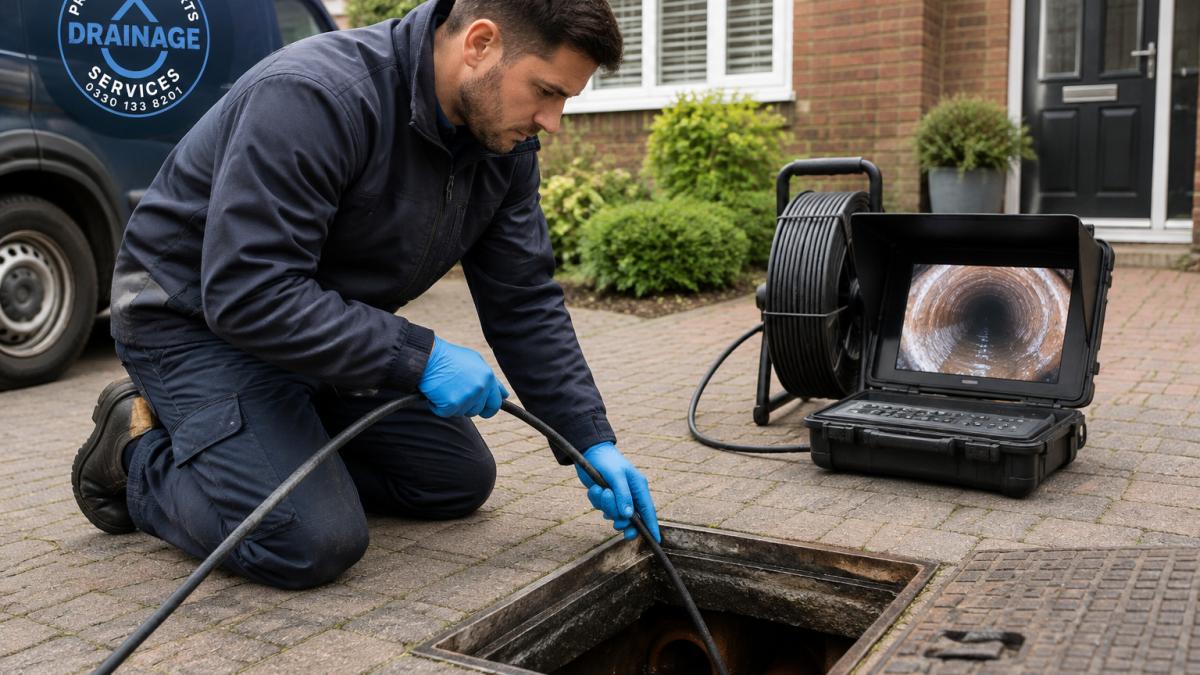
Sellers who commission a survey before going to market gain two advantages. First, they find out about defects while they still have time to choose the repair method. Second, they can show buyers a clear report, which builds trust and reduces the chance of a price cut at the last minute.
If you are wondering what a survey will cost, check our pre-sale drainage survey pricing to see how the service works. Our team uses high-resolution cameras to inspect drains, identify blockages or damage, and provide accurate reports without excavation.
Reading a Professional Drainage Report Step by Step
A good drainage report is easy to read once you know what to look for. Work through it in this order:
- Check the summary. It should list the main findings and any urgent issues.
- Look at the survey route. The report should map each drain run, with manhole or chamber references.
- Review the footage notes. Each defect should have a timestamp and a short description.
- Note the severity grade. Most reports grade faults from minor to urgent.
- Read the recommendations. These tell you whether to clean, patch, reline or replace.
- Ask about the cost of each option. Repairs should come with clear, itemised pricing.
Reports from Pro Drain Experts follow this structure, which makes it easier to compare options before you decide. A clear report also helps your estate agent and any buyer's solicitor understand what has been done.
Selling a House with Drainage Problems: Your Options
You have three main routes when a survey finds a fault before sale.
- Repair before listing. This removes the issue and gives buyers confidence. It works best when the fault is clear and the repair is quick.
- Disclose and reduce the price. This suits older faults or repairs that are hard to predict. Buyers can then decide whether the discount is fair.
- Sell as seen with a known defect. Buyers who expect a discount may accept this. Expect fewer offers and longer time on the market.
Each route has trade-offs. A repair costs money now but protects the sale price. A price cut keeps your costs down but can leave money on the table. Your estate agent and solicitor can help you pick the right route for your situation.
Drain Repairs Before Selling a Property: Cost Versus Price Reduction
Repairing a drain before sale can be cheaper than accepting a buyer's discount, but not always. The decision comes down to four numbers: the repair quote, the likely discount, the time cost of delay, and the risk that the fault is worse than the survey suggests. Work through them in that order.
Step 1: Get a fixed repair quote, not an estimate
Ask a drainage contractor for an itemised quote that separates the investigation, the repair method (clean, patch, reline or excavate-and-replace), the reinstatement of any driveway, patio or lawn, and VAT. A reline of a short run is usually far cheaper than excavation because it avoids digging up finished surfaces. A quote that says 'from £X' is not a quote; ask for the upper figure in writing.
Step 2: Estimate the discount a buyer will actually seek
Buyers rarely ask for the bare repair cost. A common pattern is that a buyer's solicitor or surveyor will price in the repair, a contingency for the unknown, and the disruption of living on a building site. Most practitioners find the resulting reduction lands well above the contractor's quote, particularly where the drain runs under a conservatory, extension or driveway. Ask your estate agent what reduction they would expect on your street for the same defect; local sold-price evidence is more reliable than a national rule of thumb.
Step 3: Price the time cost of delay
A repair before listing typically adds a few weeks to your timeline. A price negotiation after survey can add longer, because the buyer may renegotiate, re-survey or withdraw. If you are in a chain, or buying onward, the cost of a delayed completion can outweigh the saving from a discount. Compare the two timelines honestly before deciding.
Step 4: Weigh the risk of a worse-than-expected fault
A CCTV survey grades defects, but it cannot always show the full extent of a collapsed section until the pipe is exposed. If you repair first, you carry that risk. If you discount, the buyer carries it and will price it in. For older properties across Sussex, where clay-heavy soil and mature trees can make root ingress more common, the risk of a hidden fault is higher, and buyers know it.
A simple decision rule
- Repair first when the quote is clearly below the likely discount, the repair is quick, and the fault is well defined.
- Disclose and discount when the repair is disruptive, the fault is uncertain, or you need to move quickly.
- Sell as seen only for minor, clearly disclosed defects where you accept a smaller pool of buyers.
Watch out: a buyer who obtains their own survey after you have repaired may still negotiate on other findings, so keep the repair report and any guarantee ready to show.
What to keep for the buyer
Keep the CCTV footage, the contractor's report, the repair invoice and any guarantee or insurance-backed warranty. These documents shorten the buyer's enquiries and give their solicitor less room to argue for a retention. A retention is a sum held back from the sale proceeds until a defect is fixed; it delays your completion and is best avoided by showing the work is done.
The decision between repairing a drain and accepting a buyer's discount comes down to four numbers, summarised below.
| Step | What to do | Key point |
|---|---|---|
| 1. Get a fixed quote | Ask for an itemised quote in writing | Ask for the upper figure, not 'from £X' |
| 2. Estimate the discount | Ask your agent what reduction local buyers seek | Buyers often price above the repair cost |
| 3. Price the time cost | Compare repair-first and discount timelines | Delay can outweigh a discount |
| 4. Weigh the risk | Consider a worse-than-expected fault | Hidden faults show only after exposure |
Insurance, Disclosure and Your Legal Obligations in England and Wales
Drainage defects sit at the intersection of three obligations: what you must tell the buyer, what your buildings insurance will cover, and what your lender or buyer's lender will require. Getting any of them wrong can delay or derail a sale.
Disclosure: the TA6 Property Information Form
In England and Wales, sellers complete the TA6 Property Information Form. It asks direct questions about drainage, including whether the property is connected to mains drainage, whether there have been any drainage problems, and whether any repairs have been carried out. You must answer honestly and to the best of your knowledge. A 'not known' answer is acceptable only if you genuinely do not know; it is not a way to avoid disclosing a fault you have seen.
If a CCTV survey has found a defect, disclose it and attach the report. Disclosure with evidence is almost always better than a buyer discovering the fault later, because a known and documented defect is easier to negotiate than a concealed one. Concealment can lead to a claim after completion, and your solicitor will advise on the risk.
Insurance: what policies typically cover and exclude
Most buildings insurance policies cover 'escape of water' from fixed pipes and appliances, but the cover usually applies to the resulting damage, not to the cost of fixing the defective pipe itself. Wear and tear, gradual deterioration, root ingress and poor workmanship are commonly excluded. That distinction matters: a burst pipe that damages a kitchen floor may be covered, while a slowly leaking drain that softens a foundation may not be.
A recorded repair changes the picture. Insurers ask about previous claims and about defects you know of. If you have had a drain repaired, keep the invoice and any guarantee, because a future buyer's insurer may ask for evidence that the issue was addressed. Some policies also require you to maintain drains and to report leaks promptly; failing to do so can give an insurer grounds to reduce a payout.
Premiums and eligibility
A history of drainage claims or a known unresolved defect can affect a buyer's ability to get cover, and in some cases can raise the premium or lead an insurer to impose an exclusion for subsidence or escape of water. This is one of the least discussed effects of drainage problems on property value: a property that is hard to insure is harder to sell, and buyers with a mortgage will need cover in place before completion. If you are unsure how your history will be treated, ask your broker for an indication before you list.
Indemnity policies and when they help
An indemnity policy is an insurance policy that covers a specific legal or title risk, such as a lack of building regulations approval for a drain repair or an absence of an adoption agreement for a private sewer. Indemnity policies are not a substitute for repairing a defective drain, and insurers will not cover a defect you already know about. They are most useful for historic paperwork gaps, not for live physical faults. Your solicitor will tell you whether one is appropriate.
Private sewers and adoption
Changes to the responsibility for private sewers in England and Wales mean that some previously private drains may now be the responsibility of the water company (The private sewers transfer regulations). Not all are, however, and the position depends on what the drain serves and where it runs. If a survey shows a defect in a drain that may be the water company's responsibility, check with the company before paying for a repair yourself. This can materially change both the cost and the disclosure position.
Watch out: do not assume a defect is the water company's responsibility just because it is outside your boundary; confirm it in writing before you rely on it in a sale.
For the current forms and guidance, take advice from your solicitor on your specific answers before you list.
Booking Your Drainage Survey Before You List
Book the survey before you put the house on the market. That gives you time to act on the findings without rushing the sale. Most sellers find that a short survey now saves a long delay later.
When you are ready to book, get in touch about blocked drains and drainage work in Lewes or look through our past drainage survey and repair work to see the kind of jobs we handle. Our team responds the same day in most cases, so you can move quickly if your agent needs the report by a set date.
Keep a copy of the survey report with your sale paperwork. It shows buyers and their surveyors that you have checked the drains and acted on any findings.
Frequently Asked Questions
Can drainage problems reduce a property's value?
Yes. Drainage defects such as collapsed pipes, root intrusion or persistent blockages can lower the price a buyer is willing to pay, particularly when a survey flags them as needing excavation. Buyers often budget for the worst case, so an unresolved defect can reduce offers by more than the cost of the repair itself. Getting a CCTV drain survey and a clear professional drainage report early lets you show buyers the condition of the system and reduces the scope for price negotiation based on uncertainty.
Should I get a CCTV drain survey before selling my property?
In many cases, yes. A CCTV drain survey shows the actual condition of the pipework rather than guesswork, and it gives you the chance to repair problems on your own terms before a buyer's surveyor finds them. Pro Drain Experts offers CCTV surveys across East Sussex, West Sussex and Kent with detailed reports and recommendations. For current prices, contact Pro Drain Experts directly for a quote, as costs depend on the length of pipework and access.
What does a professional drainage report include?
A professional drainage report usually records the route and depth of the drains, any defects found during the camera inspection (such as cracks, displaced joints, root ingress or standing water), the location of each defect, and recommendations for repair or further work. Good reports include annotated footage or stills so you and any buyer can see exactly what the engineer saw. Pro Drain Experts provides detailed reports with clear recommendations, which can be shared with a conveyancer or prospective buyer.
Do I have to disclose drainage problems when selling a house in the UK?
Sellers should answer property information questions honestly, and known defects should be disclosed. Failing to mention a drainage problem you are aware of can expose you to claims after completion. Speak to your conveyancer about what to declare, and keep any drainage reports and repair invoices, as these help demonstrate what has been fixed and when.