 How-to
Identifying Red Flags in Drainage Reports: A UK Buyer's Guide
Last Updated: November 4, 2026
Quick Summary
Identifying red flags in drainage reports means checking for collapses, fractures, root ingress and restricted flow first, then reading the defect log and grade key. Cracks, displaced joints and repeated defects in the same run need the closest attention before you buy or manage a property.
- Read the observation log and note defect codes that appear more than once in the same run.
- Check whether the camera reached the full pipe run, since a blockage can hide defects.
- Treat high-grade defects such as major fractures or collapses as urgent and act before completion.
- Ask for a written quote that matches every defect in the report line by line.
Table of Contents
- Why Drainage Reports Matter Before You Buy or Manage a Property
- CCTV Drain Survey Report Explained: Reading the Findings Line by Line
- The Most Serious Red Flags: Collapses, Fractures and Root Ingress
- Drain Survey Structural Condition Grades Explained
- Drain Survey Report Examples: What Good and Bad Look Like
- Drain Survey Defects and Recommendations: Prioritising by Severity and Urgency
- Surface Warning Signs That Point to Hidden Drainage Faults
- Questions to Ask Your Surveyor, Seller or Drainage Contractor
- Booking Your Next Step: Arranging a Drainage Assessment With Pro Drain Experts
- Frequently Asked Questions
Why Drainage Reports Matter Before You Buy or Manage a Property
Drainage problems rarely show themselves until they are expensive. A drain can look fine from the surface while it cracks, sags or fills with roots underground. Identifying red flags in drainage reports early gives you time to ask the right questions and negotiate sensibly. Pro Drain Experts, which has over 20 years of experience, covers East Sussex, West Sussex and Kent, and the same warning signs come up again and again.
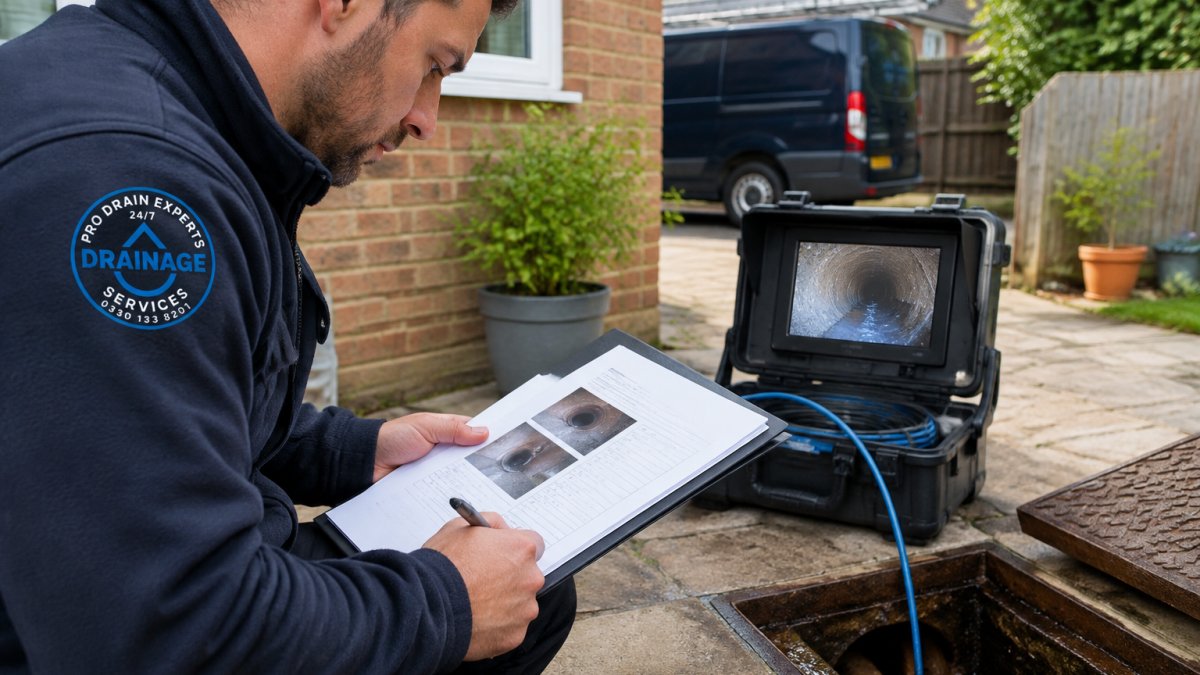
A drainage report is the written record of what a CCTV camera found inside a pipe run. It lists defects, their location and often their severity. For buyers, it is the only way to see what sits beneath the lawn and the patio. For landlords and managers, it is the baseline for planning repairs before a small fault turns into a flooded kitchen.
Many buyers assume a standard property survey covers the drains. It usually does not. Most general surveys only check drains visibly, at the manhole or inspection chamber. A camera survey goes further, which is why it is worth knowing what to look for. You can read more in our guide to whether CCTV drain surveys are worth it for home buyers, and check typical cost of a pre-purchase CCTV survey in 2026 before deciding.
Drain ownership is often shared between the property and the public sewer network, so responsibility can be unclear. A clear report helps you establish where a fault sits before you agree to take it on.
CCTV Drain Survey Report Explained: Reading the Findings Line by Line
A CCTV drain survey report usually follows a set pattern. It gives a survey date, the pipe runs inspected, and a list of observations. Each observation has a code, a distance from the access point and a short description. Learning the layout makes the important lines easy to spot.
Here is what the main parts of a report typically include:
- Survey details: date, property address and the access points used
- Pipe run data: diameter, material and length of each section surveyed
- Observation log: each defect, with its distance in metres from the manhole
- Still images or video: frame captures showing the defect
- Summary and recommendations: the surveyor's view on urgency and next steps
Defect codes and what they usually mean
Most reports use a coding system so each observation can be recorded in shorthand. The exact codes vary between surveyors, but a common pattern is a short letter or number code followed by a description and a distance. Typical entries you may see include:
- Crack, fracture or broken pipe: often recorded as a structural defect, with a note on whether the crack is longitudinal (running along the pipe) or circumferential (around the pipe).
- Displaced joint: the pipe sections have moved apart, leaving a gap where roots and soil can enter.
- Root ingress: roots have entered through a joint or crack, usually with a note on how much of the bore is affected.
- Debris or sediment: material sitting in the pipe that reduces flow, sometimes described as a percentage of the bore.
- Obstruction or blockage: something preventing the camera from passing, which may mean the full run was not surveyed.
- Deformation or ovality: the pipe has lost its round shape, often through ground pressure.
- Infiltration: groundwater entering the pipe through a defect.
Read the observation log first. Note any defect codes that appear more than once, as repeated faults in the same run often point to a wider problem. Then check the distances, since two faults a short way apart may sometimes be addressed together.
Pipe materials and why they matter
Reports usually state the pipe material for each run, because the material affects how a defect behaves and how it can be repaired. Common materials in UK properties include clay, concrete, cast iron, pitch fibre and plastic. Clay and concrete pipes are rigid and can crack under ground movement; pitch fibre, used in some mid-twentieth-century properties, can deform and collapse over time. Plastic pipes are more flexible but can still be displaced at joints. If the report names the material, use it as a prompt to ask the surveyor whether the defect is typical for that material and what repair method suits it.
Severity ratings and the report key
Many reports rate each defect on a grading scale. Scales vary between surveyors, so always read the key at the front of the report rather than assuming what a number means. A common approach uses grades that run from minor to severe. A low grade usually means a defect to monitor. A middle grade often calls for repair within a set timeframe. A high grade generally means urgent action to prevent collapse or flooding.
Check the grade against the description. A high grade attached to a small surface mark may point to an error, so ask the surveyor to confirm. Treat the grade as a guide to priority rather than a precise measure of cost.
Watch out: a report that only lists "no defects" for a short section may simply mean the camera could not pass a blockage. Ask whether the full run was reached and, if not, why.
The Most Serious Red Flags: Collapses, Fractures and Root Ingress
Some defects need urgent attention. Collapses, fractures and root ingress can all restrict flow, cause leaks and damage the ground around the pipe. These are the faults to take most seriously when you read a report.
Cracks and Fractures: What They Mean
A crack in a drain may look minor on the screen, but it can widen over time. Hairline cracks in clay or concrete pipes often mean the pipe is under strain from ground movement or poor bedding. Longitudinal and circumferential cracks carry different risks, so check the report's description for each.
Fractures that let water escape can soften the soil around them. Over time this may show up as sinking paving or damp patches at the surface. If a report flags a fracture, ask the surveyor whether it is a crack, a break or a displaced joint, as each needs a different fix.
Root Ingress and Restricted Flow
Tree roots find their way into pipes through joints and small cracks. Once inside, they catch debris and slowly block the bore. A report will often describe this as root ingress, with a note of how much of the pipe is affected.
Restricted flow shows up as a reduced water level, a build-up of sediment or a partial blockage. If a report mentions a restriction, it is worth asking how often the drain has needed clearing. Repeated blockages often mean the underlying defect has not been dealt with.
Drain Survey Structural Condition Grades Explained
Many reports rate each defect on a grading scale. Scales vary between surveyors, so always read the key at the front of the report rather than assuming what a number means.
A common approach uses grades that run from minor to severe. A low grade usually means a defect to monitor. A middle grade often calls for repair within a set timeframe. A high grade generally means urgent action to prevent collapse or flooding.
Check the grade against the description. A high grade attached to a small surface mark may point to an error, so ask the surveyor to confirm. Treat the grade as a guide to priority rather than a precise measure of cost.
Most reports rate each defect on a grading scale, so the table below summarises what each band usually signals, based on the article's guidance.
| Grade band | Typical meaning | Suggested action |
|---|---|---|
| Low grade | Defect to monitor | Re-inspect at next survey interval |
| Middle grade | Repair needed within a set timeframe | Price and schedule the repair |
| High grade | Risk of collapse or flooding | Urgent action |
| Unclear grade | Scale differs between surveyors | Read the report key and confirm with surveyor |
Drain Survey Report Examples: What Good and Bad Look Like
A good report is clear, specific and complete. It shows the whole run, includes images for each defect, and gives distances in metres. The recommendations explain what to do and why, rather than just listing repairs.
A poor report tends to be vague. Watch for these signs:
- Defects listed without distances or locations
- No images or video frames to support the findings
- The full run not reached, with no explanation
- Recommendations that are generic or missing
- Grades given with no key to explain them
If your report looks like the second list, ask the surveyor to clarify before you rely on it. A reputable provider will be happy to explain their findings.
Drain Survey Defects and Recommendations: Prioritising by Severity and Urgency
Not every defect needs fixing at once. Good recommendations separate urgent work from routine maintenance and from items to monitor. This helps you plan both the budget and the timing, and it gives you a basis for negotiation if you are buying.
A simple triage framework
Sort every observation in the report into one of four bands:
- Immediate health or structural risk: defects that are blocking flow, causing sewage to escape, or threatening collapse or subsidence. Examples include a major fracture, a collapsed section, severe root ingress or a defect under a building or retaining wall. These need action before completion or very soon after.
- Short-term repair: defects likely to worsen within months, such as cracks, displaced joints and moderate root ingress. These should be priced and scheduled rather than left indefinitely.
- Monitor: minor marks, light sediment or small surface defects that do not affect flow at present. Record them and re-inspect at the next survey interval.
- Investigate further: anything the camera could not reach, or a defect whose cause is unclear. Ask for a further survey or a second opinion before deciding.
Linking defects to repair options and indicative costs
Once you have sorted the list, connect each band to a likely next step. Minor defects may need only cleaning or monitoring. Cracks and displaced joints may be repairable with a localised patch or lining. Severe root ingress may need cutting and lining. A collapsed or deformed pipe may need excavation and replacement. Ask the contractor to state which method they propose for each defect and why.
Indicative costs vary widely with access, depth and pipe run length, so treat any figure as a starting point rather than a quote. Ask for a written quote that lists each defect separately, so you can see what is urgent and what can wait. If a seller is involved, the report and quotes give you a factual basis to ask for a price reduction, a repair before exchange, or a retention to cover the work.
Using the report in a purchase or management plan
For buyers, the priority is to know what you are taking on. Ask the seller for any previous surveys, guarantees or repair invoices, and check whether the defects found are new or have been monitored. For landlords and managers, use the triage to build a maintenance plan: urgent items first, short-term repairs in the next budget cycle, and monitoring items on a scheduled re-inspection.
Watch out: a quote that does not match the report line by line can leave urgent defects unpriced. Check that every immediate and short-term item has a corresponding line in the quote before you rely on it.
Ask for an estimated timeframe for each urgent item. Ask whether any defects are linked, since one repair may solve several problems. Quotes should match the recommendations, so check that each defect has a matching line in the price.
Surface Warning Signs That Point to Hidden Drainage Faults
Often the first sign of a drain fault is above ground. A patch of unusually lush grass, a damp area near a boundary or a sinking paving slab can all point to a leak underneath. Foul smells near a drain cover and slow-draining sinks inside the property are also common clues.
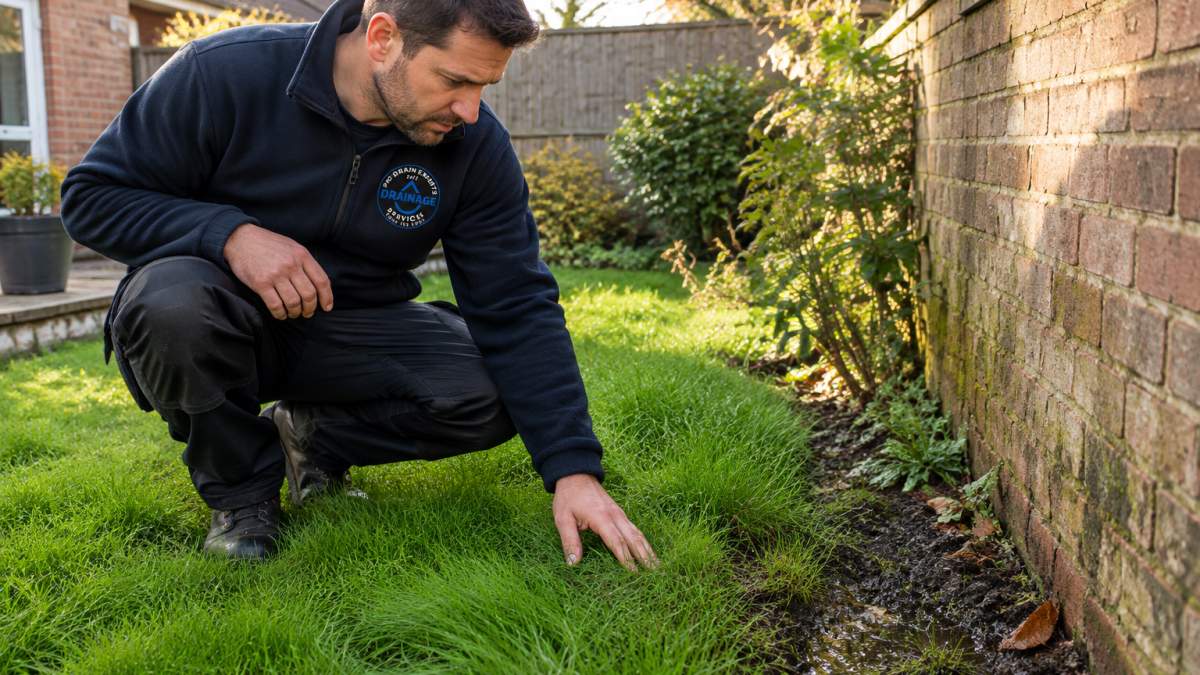
Look for these signs during a viewing or inspection:
- Patches of greener, healthier grass over a single run
- Soft or spongy ground near inspection covers
- Damp walls or mould near external drain routes
- Gurgling sounds or slow drainage in several fittings at once
- Unexplained cracks in paths or patios along a drain route
Any one of these may have a simple cause. Several together justify a camera survey before you commit to a purchase.
Questions to Ask Your Surveyor, Seller or Drainage Contractor
Clear questions help you get useful answers. Ask them before you agree to anything.
For the surveyor:
- Was the full pipe run reached, or was the camera stopped by a blockage?
- Which defects are urgent, and which can wait?
- Are any defects linked, so one repair fixes several?
- Can you show me the images for the most serious findings?
For the seller or landlord:
- Has the drain ever been surveyed or repaired before?
- Have there been any blockages, leaks or flooding in the last few years?
- Who is responsible for the section under the garden, the property or the public sewer?
For the drainage contractor:
- Does your quote match every defect in the report?
- Will the work be guaranteed, and for how long?
- What happens if you find something worse once work begins?
We believe in up-front pricing with no hidden fees, so ask for a written quote that lists each item. You can also check our CCTV drain survey pricing explained guide before you ask for quotes.
Booking Your Next Step: Arranging a Drainage Assessment With Pro Drain Experts
If a report raises questions, or you want a camera survey before you buy or manage a property, the next step is a proper assessment. Our team covers East Sussex, West Sussex and Kent and provides detailed CCTV reports with clear recommendations. We offer 24/7 emergency call-outs and a same-day response, so urgent faults can be looked at quickly.
To learn more about the CCTV drainage survey service and what it covers, you can read our page. If you have a blocked drain, our local blocked drains service explains how we help.
Frequently Asked Questions
What should a drainage report include?
A professional drainage report should set out what the survey covered, including the length and route of each drain inspected, the access points used, and the condition of the pipework as seen on CCTV. It should record each defect with its location, a description, a severity or structural grade, and a clear recommendation such as monitor, repair or further investigation. Good reports also note limitations, such as sections that could not be reached or blocked by debris, and include video or still images so the findings can be checked. If a report gives no locations or recommendations, ask the surveyor to clarify before relying on it.
What are the most serious red flags in a drainage report?
The most serious red flags are collapsed or severely fractured pipes, significant root ingress, displaced joints, and any defect marked as requiring urgent attention. These indicate that wastewater may be escaping into the ground or that a drain may fail completely. Repeated blockages, standing water in the survey route and evidence of past repairs that were not properly completed also deserve close attention. A report with several of these findings in one line usually signals a need for prompt, professional repair rather than routine maintenance.
Should I be worried about a drainage report marked as urgent?
An urgent marking means the surveyor believes the defect could worsen quickly or cause damage to the property if left alone. It is not automatically a reason to walk away from a purchase, but it should be treated seriously. Ask for a quotation for the repair, check whether the defect affects a shared drain, and find out whether the seller has already arranged work. Arranging a second opinion from a qualified drainage contractor is a sensible step, particularly before exchanging contracts.
Can I negotiate a property purchase after a drainage survey finds problems?
Yes, a drainage survey that identifies defects can give you grounds to negotiate. Use the report and a repair quotation to ask for a reduction in price, for the seller to carry out the repair before completion, or for a retention to cover the cost. The strength of your position depends on how serious the defects are and how clearly they are documented, so keep copies of the report, video footage and written quotes. Your conveyancer can help you put the request to the seller in writing.
Get in touch with Pro Drain Experts to arrange a drainage assessment at your property. Our team is ready to help you read your report with confidence, so you can make your next move knowing exactly what sits beneath the surface.