 How-to
How to Detect Hidden Slab Leaks at Home
Quick Summary
A slab leak is a leak in a water pipe running under a concrete floor, usually beneath a ground-floor kitchen, bathroom or utility room. You can spot one through an unexplained rise in your water bill, damp or warm patches on floors, and running-water sounds when no tap is on. A water meter test with all taps off can confirm whether water is still flowing.
- Compare your latest water bill with the same period last year for unexplained increases.
- Turn off all taps and appliances, then wait at least 30 minutes before rechecking the meter.
- Watch out: a running toilet cistern can cause meter movement, so check it first.
- Feel floors for warm spots, especially over hot-water pipes, and look for damp patches or staining.
- Shut off the main stopcock and call a professional if you see standing water or soft flooring.
Table of Contents
- What Is a Slab Leak and Why It Often Goes Unnoticed
- Signs of a Slab Leak to Look For at Home
- Water Meter Leak Test: Checking for Movement with Every Tap Off
- A Safe, Ordered Checklist for Homeowners
- Professional Slab Leak Detection Methods and Their Limits
- Slab Leaks Versus Other Underfloor Leaks in Ringmer and East Sussex Homes
- What to Do If You Suspect a Slab Leak Right Now
- Costs, Insurance and Who Pays for a Slab Leak Repair
- Booking Your Leak Investigation with Pro Drain Experts
- Frequently Asked Questions
What Is a Slab Leak and Why It Often Goes Unnoticed
Last Updated: November 5, 2026
A slab leak is a leak in a water pipe that runs under a concrete floor slab, usually beneath a ground-floor kitchen, bathroom or utility room. Because the pipe sits hidden inside or under concrete, water escapes without showing on the surface, so it can run for weeks or months before anyone spots it.
The leak often goes unnoticed because the water has nowhere obvious to go. It seeps into the ground beneath the slab, soaks the surrounding soil, and slowly damages flooring and walls above. Many homeowners only realise something is wrong when a floor feels cold or a skirting board starts to lift.
This guide shows you how to spot the warning signs, run simple checks at home, and understand what professional detection involves. Start with the simple checks first, and call for help if they point to a problem.
Signs of a Slab Leak to Look For at Home
The most common signs are a rise in your water bill, damp or warm patches on floors, and sounds of running water when no tap is on. Each sign on its own can have other causes, so look for two or more together.
Unexplained rises in your water bill
A sudden jump in your water bill, with no change in how your household uses water, is one of the clearest early signs. Compare your latest bill with the same period last year, and note any increase that you cannot explain by guests, a new appliance or a change in habits.
- Check whether your bill is estimated or based on a real meter reading
- Note the date and amount of the last two or three bills
- Look for a steady climb rather than a one-off spike
Damp patches, staining and warm spots on floors
Damp patches on a floor, staining on skirting boards, or a section of flooring that feels noticeably warm can point to water escaping under the slab. A warm spot is a particular warning sign if it sits over a hot-water pipe, because hot water leaking into the ground gives off heat you can feel through the floor.
- Feel the floor with your bare hand in several spots, especially near kitchen and bathroom walls
- Look for tiles that are loose, cracked or discoloured
- Check the bottom of walls and skirting boards for lifting paint or swelling
Running-water sounds, low pressure and musty smells
If you hear water running or dripping when every tap and appliance is off, that is a strong clue. A drop in water pressure at one or more taps, or a damp, musty smell that never quite clears, can also mean water is escaping somewhere in the house.
- Turn off all taps and appliances, then listen quietly in the kitchen and bathroom
- Compare water pressure at a tap close to the main supply with one further away
- Notice whether the smell is worse in one room or near a particular wall or floor
Water Meter Leak Test: Checking for Movement with Every Tap Off
The water meter test is one of the simplest checks you can make, and it needs no tools. It tells you whether water is flowing through your supply when nothing in the house should be using it.
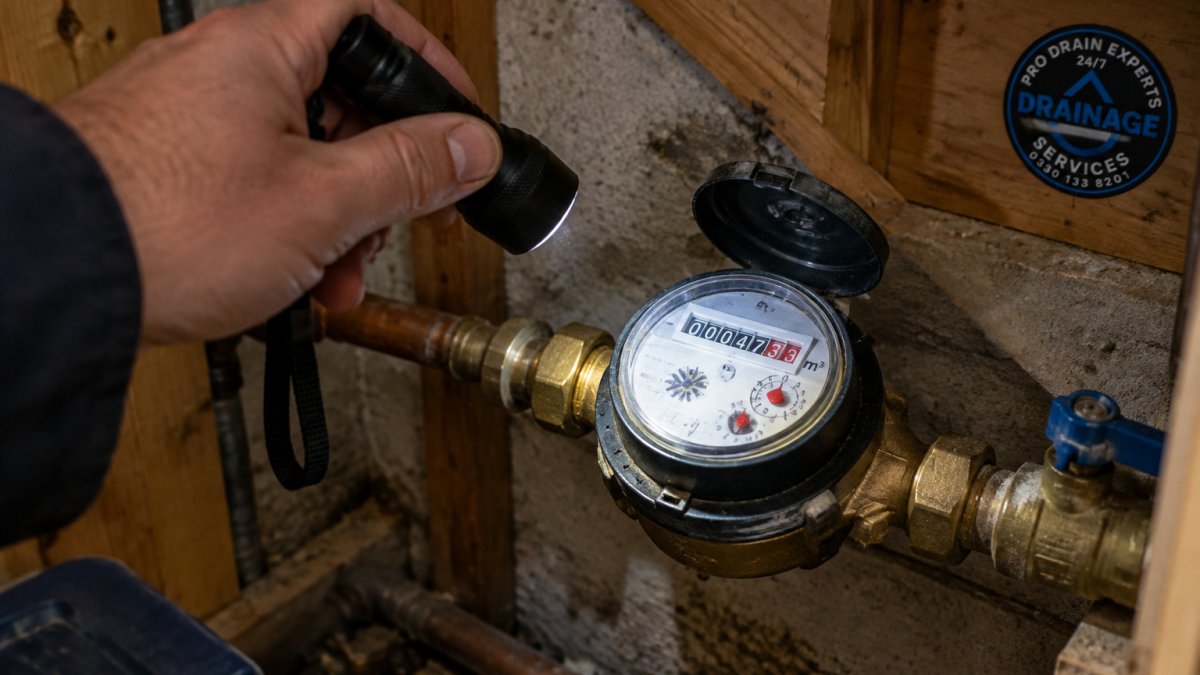
!Close-up of a homeowner's hand holding a torch over a water meter in a dim under-stairs cupboard, with the dial visible
Follow these steps:
- Turn off every tap, shower, washing machine, dishwasher and outdoor hose.
- Find your water meter, usually in the kerb, a footpath box or an under-stairs cupboard.
- Open the cover and locate the leak indicator, which is often a small triangle or dial.
- Note the meter reading and check whether the indicator is moving.
- Wait for at least 30 minutes without using any water, then check the meter again.
If the reading has changed, or the leak indicator keeps turning, water is still flowing somewhere. Watch out: a running toilet cistern can cause the same movement, so check the cistern before assuming the leak is under the slab.
A Safe, Ordered Checklist for Homeowners
Work through these checks in order. Stop as soon as you find something that needs professional help.
- Compare your latest water bill with the same period last year
- Turn off all taps and appliances, then listen for running water
- Check the cistern and all toilets for silent running or leaks
- Carry out the water meter test over at least 30 minutes
- Feel floors for warm spots and check for damp patches or staining
- Note any musty smells and which room they come from
- Compare water pressure at a close tap and a distant tap
- Record your findings with dates and photos where possible
Keep your own safety in mind throughout. Do not lift floor coverings or dig into the floor yourself, and never work near electrical sockets while standing in water. If anything looks like a serious or active leak, shut off the main stopcock and call a professional.
Professional Slab Leak Detection Methods and Their Limits
A professional will usually combine more than one method because no single technique finds every leak. The choice depends on what your symptoms suggest, the floor construction, and how much disruption you are willing to accept. Ask which methods are planned and what each can and cannot confirm before work starts.
Acoustic listening
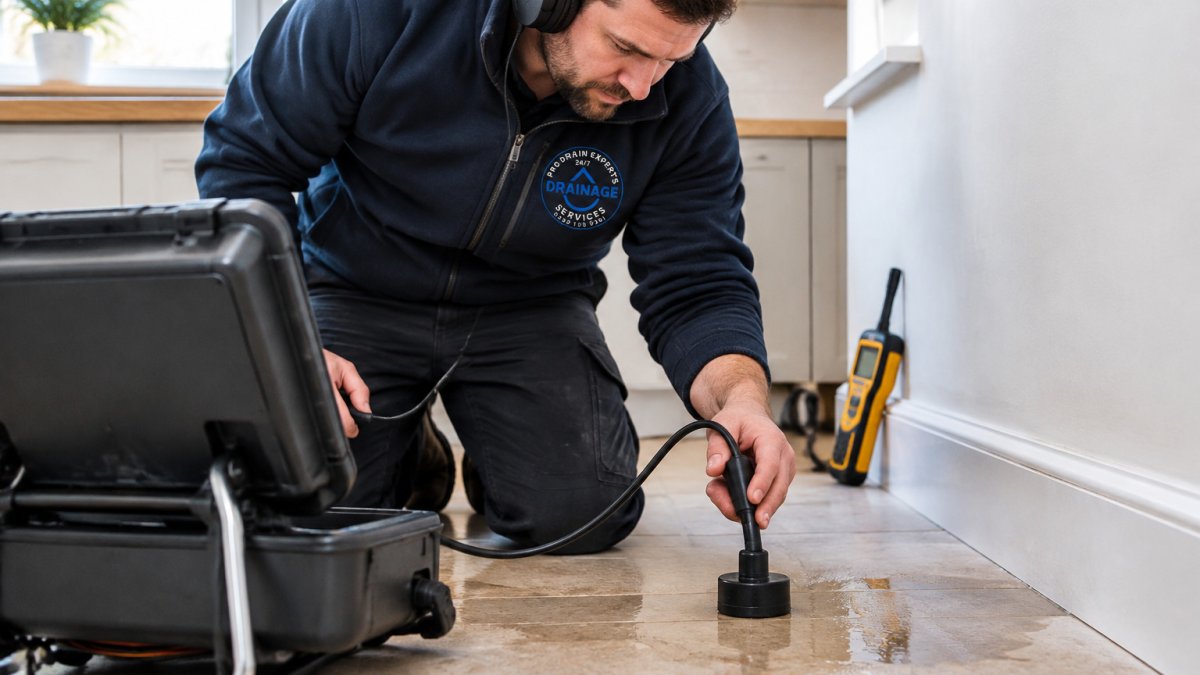
Acoustic listening uses sensitive microphones or ground microphones to pick up the sound of escaping water through concrete, screed and pipework. It is usually the first step because it is non-invasive and needs no opening up. It works best on pressurised supply pipes and can narrow a leak to a small area, but it rarely pinpoints the exact spot. Background noise from appliances, traffic or nearby plumbing can mask the signal, and a leak that has soaked into soil may be almost silent.
Pressure testing
Pressure testing isolates a section of the water system, pressurises it, and watches whether the pressure holds. A drop shows water is escaping somewhere in that section. It is reliable for confirming that a leak exists and for ruling sections in or out, but it does not tell you where the leak is. It also requires access to isolation valves and may mean temporary disruption to the supply.
Thermal imaging
Thermal imaging uses an infrared camera to show temperature differences across a floor. It is strongest for hot-water leaks, which create warm patches, and can mark an area for closer investigation without lifting finishes. It is much less useful for cold-water leaks, and sunlight, underfloor heating or recent hot-water use can create false warm spots.
Tracer gas
Tracer gas testing introduces a safe gas mixture into a sealed section of pipe and uses a detector at floor level to find where it escapes. It can be very precise for small leaks and works on both hot and cold supplies, but it needs the section to be drained and sealed, and the gas must be handled by a trained technician. It is often used when acoustic and thermal methods are inconclusive.
Choosing between methods
| Method | Best for | Main limitation | Disturbs finishes? |
|---|---|---|---|
| Acoustic listening | Pressurised supply leaks | Background noise; cannot pinpoint | No |
| Pressure testing | Confirming a leak exists | Does not locate it | No, but needs valve access |
| Thermal imaging | Hot-water leaks | Cold leaks; false warm spots | No |
| Tracer gas | Small or stubborn leaks | Needs sealed, drained section | No, but needs pipe access |
Investigators often combine methods, and the right mix depends on the leak and the property. Ask your professional to explain why they chose a particular method and what the result does and does not prove.
Watch out: a cheap "leak detection" visit that uses only one method and then recommends immediate digging may be skipping the confirmation step; ask for the evidence behind the location before any floor is opened.
Slab Leaks Versus Other Underfloor Leaks in Ringmer and East Sussex Homes
A slab leak is specifically a leak in a pipe set within or under a concrete slab. Other underfloor leaks can happen in suspended timber floors, where pipes run beneath floorboards in a void, or in pipework that runs through the ground outside the building.
In many homes, ground-floor kitchens and bathrooms may sit on concrete, while other rooms have timber floors. The location of the damp, the type of floor, and the route of the pipes all help show which kind of leak you may be dealing with.
The distinction matters because the detection method and the repair plan differ. A timber-floor leak may be reached from below or by lifting boards, while a slab leak usually needs more specialist investigation before any digging begins.
What to Do If You Suspect a Slab Leak Right Now
If you suspect a hidden leak is causing active damage, act quickly to limit the harm.
Shut off the main stopcock to stop the flow of water into the house. For a fuller walkthrough of what to do next, follow this step-by-step emergency guide. Know where it is before you need it, and keep the key or handle somewhere easy to reach. Then turn on the heating if it is cold, to help dry the property and reduce the risk of mould.
Move valuables, rugs and furniture away from damp areas. Place towels or buckets under dripping points, and open windows to improve airflow. Take photos and note the dates of any damage, which will help with an insurance claim.
Call a professional without delay if you see standing water, if a floor is becoming soft, or if the water bill and meter tests point to a continuing leak. Pro Drain Experts offers 24/7 emergency call-out services, so you can get help outside normal working hours. Our same-day response promise means you can often have an engineer on site quickly.
Costs, Insurance and Who Pays for a Slab Leak Repair
Repair costs vary widely because the work depends on the leak location, the floor construction, and how much finish has to be removed and replaced. Pricing depends on the methods used, the time on site, and how much of the floor must be opened and reinstated. For a broader view of realistic ranges, see how much drainage repair typically costs. Pro Drain Experts offers up-front pricing, so please contact us or visit our website for a current quote. Always ask for a written quote that separates detection, access, repair and reinstatement.
Quote factors to check include:
- Whether detection is charged separately or credited against the repair
- The area and depth of floor to be opened
- Whether the pipe will be repaired in place or rerouted
- The cost of matching and refitting tiles, screed or flooring
- Whether making good and waste removal are included
- Any call-out or out-of-hours charge
Insurance and trace-and-access cover
Whether your policy pays depends on the wording and the cause. Many UK buildings and contents policies cover "trace and access", the cost of finding and accessing a leak, but limits and exclusions vary, so check your policy wording. Read more about whether emergency drain repair is covered by insurance. Check your excess and whether the policy covers reinstatement of the floor. Keep all reports, photos and invoices, and speak to your insurer before authorising work so the claim process is followed.
Who is responsible for the pipe
Responsibility depends on where the pipe runs. Responsibility for water pipes depends on where they run, so check the boundary with your water supplier. If the leak is on the company side, report it to your supplier. If it is on your side, it is your responsibility, although some companies offer repair schemes. Check with your water supplier to confirm the boundary before assuming who pays.
Watch out: authorising a repair before your insurer has agreed the claim can leave you out of pocket, so notify them first and keep the damaged sections available for inspection where it is safe to do so.
Booking Your Leak Investigation with Pro Drain Experts
If the checks in this guide point to a hidden leak, a professional investigation is the next step. Pro Drain Experts has over 20 years of experience and offers up-front pricing with no hidden fees. Our team provides detailed reports and recommendations from CCTV surveys so you know what has been found and what needs doing.
We have carried out a range of leak and plumbing work locally, including Laughton tap replacement, which shows the kind of practical repair work we complete for homeowners in the area.
Call our 24/7 emergency line to book a leak investigation or get a same-day response. Our team will explain the options clearly, give you a straightforward quote, and help you decide on the right next steps for your home.
Frequently Asked Questions
What are the signs of a hidden slab leak?
The most common signs are a water bill that rises without any change in use, a water meter that keeps moving when every tap, appliance and toilet is switched off, damp or stained patches on floors, warm spots on a hard floor that are not explained by heating, a musty smell or mould, and the sound of running water when nothing is in use. Low water pressure can also point to a leak on the supply side. Any one of these is worth checking, and several together are a strong reason to call a specialist promptly.
Can a water meter reveal a hidden slab leak?
Yes. Turn off every tap, appliance and toilet, note the meter reading, and check again after an hour or so with no water used. If the reading or the dial has moved, water is still passing through the system somewhere, which suggests a leak. The test shows that a leak exists but not where it is, so a professional is usually needed to pinpoint it. Keep a note of readings if you need to show a pattern to a plumber or your water company.
Can I detect a slab leak without breaking the floor?
Often you can narrow the problem down without lifting any flooring. Meter checks, bill comparisons and a careful look at damp, staining or warm spots all help. Professionals may use acoustic listening equipment, pressure testing or thermal imaging to locate the leak without invasive work. Each method has limits, so a non-invasive result should be treated as a strong indication to confirm rather than a guaranteed location.
When should I call a leak detection specialist?
Call a specialist as soon as you have more than one warning sign, if your meter moves with water off, or if you notice damp floors, warm patches or mould that you cannot explain. Do not wait for the damage to spread. Pro Drain Experts offers 24/7 emergency call-outs and same-day response across the area, with up-front pricing so you know the cost before work starts.